Leaderboard


Popular Content
Showing content with the highest reputation on 04/06/2017 in all areas
-
If your default rule set mimics OBR, there is no problem. Look at the OP. R3 leads off, F1 stops delivery and throws to F5...umpire yells BALK, runner scores. Since F1 threw to a base, and runner advanced, BALK (or in this case warning) is ignored. I hate leagues/tournaments that want warnings. Best way to teach proper procedure is to punish the offender...they WILL learn.2 points
-
No problem letting the infielders throw a ball while the pitcher warms up...especially of it's cold. They just can not delay the game and must be done and have the ball in at the end of the 1 minute warm-up. Sent from my SM-G928V using Tapatalk2 points
-
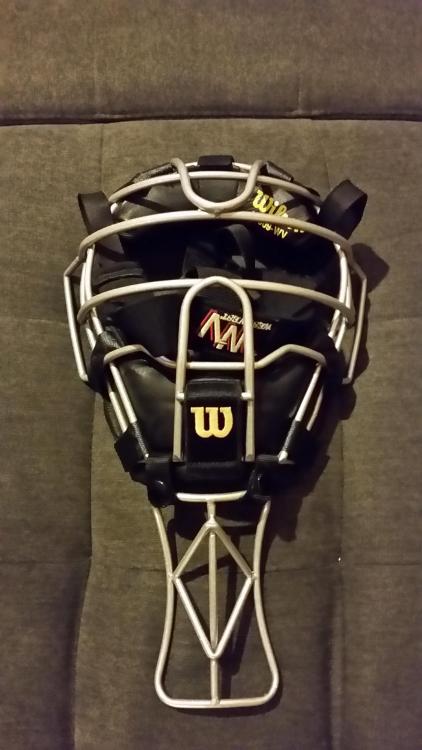
Hi all, I have a pair of black Wilson wraparound pads I'd like to sell. They're in like new condition, only worn once or twice by me. I think I got them from a member on here, but I could be wrong. If you want a picture of the backside send me a PM and I'll go fish them out of my gear bag. $30 shipped.
 1 point
 -
You have some imprecise language above, as evidenced by @noumpere post from PBUC/MLBUM, but the gist is correct. With a wild pitch or pickoff throw the balk is not ignored. It is "acknowledged for the batter absent the 'Unless" conditions.1 point
-
You're not my mom. You're not the boss of me.1 point
-
Please, don't sing!!!1 point
-
Play the core Sent from my SM-G928V using Tapatalk1 point
-
Balks are not immediately dead in LL.1 point
-
Do over is wrong. Pretending the balk didn't happen is the right way to do it.1 point
-
I think the key is that both the interpretation and case cited above include very important specific modifiers that limit their scope. The first very clearly says doing it "for the purpose of warming up as a pitcher" is prohibited....what sense would there be in making it that specific if merely tossing a ball for another purpose is generally prohibited? If not "for the purpose of warming up as a pitcher", then fine by me. Additionally, in the case, they talk about coach or bench personnel, specifically excluding players in the game. Taking these in context, players in the game can throw it around, as long as they don't delay the game (covered under other rules) or do it for the purpose of warming up as a pitcher, at least to me.1 point
-
I might differ on the mechanics with @humanbackstop19 but agree with the end result. I wouldn't call him out and then rule him safe. This invites confusion and does not look good. Recall the World Series play at 3B a few years ago. Jim Joyce pointed out obstruction on the play. The runner was clearly out trying for home on a close play. The plate ump didn't bang him out and then call him safe. Plate called him safe (If I recall, he also had pointed and yelled "That's Obstruction" picking up on Joyce's call) and then referenced the obstruction as an explanation to why he called the runner safe (who was clearly tagged before touching the plate).1 point
-
Very nice of you to say. If we ever meet in person I will sign it for you - that raises the value $0.25 Have a great season!1 point
-
Your situation describes exactly why balk warnings are not a good idea. With balk warnings, you don't allow the runner to advance, letting the defense benefit from their mistake. A pitcher could puposely balk when a runner is stealing in order to negate the advance. Leagues should not have balk warnings. Coaches should be teaching proper pitching mechanics.1 point
-
eBay finds are for people who find a real good umpire related equipment and want to share it with us in here, not for sellers that post their equipment there.1 point
-
There is nothing more scientific than that, And add me to the list of the ones who think that those are the best shin guards on the market.1 point
-
The players position is not relevant. Where the ball is relative to the foul line is what's important. Therefore as described, if in the plate umpire's judgement the ball is over foul territory , then foul ball,1 point
-
On any ball that has touched the ground before 1B or 3B, the only thing that matters is where THE BALL is when the fielder touches it. Where the fielder's feet are has no bearing on fair / foul.1 point
-
Or ... Tell F2 to go out to the mound, call F3 in and tell F3 to knock it off. Between innings, get to the head coach. Next time, enforce it.1 point
-
Are you guys playing baseball or pinball?1 point
-
Congrats - and have fun with it. A few tips I learned when I started were - 1. listen to your partner 2. let the play unfold 3. the faster the game the slower the timing 4. always be where you are supposed to be - the coaches have a good idea where you need to be to make the call 5. Have good game management and don't have thin skin or rabbit ears.1 point
-
I've actually thus far avoided the Force 3 because of the Kevlar, which was mentioned above. The high strength and stiffness of those fibers come into play when they get stretched (like, when a projectile tries to penetrate the weave in a bullet-proof vest). Amazing stuff, but alas, that's not going to happen one bit in a shinguard fabric, especially when it's hiding behind the hard shell front of the guard. It's a gimmick, pure and simple. (Or, if the designers really think it does somethIng, then that bothers me on a different level.) Granted, it sounds from folks' reviews that there are some nice design things they've done in other areas. The scientist part of me however just can't bring myself to reward this with a purchase.1 point
-
Agree. That's not how I'd handle it. Since the "substitution" is not official, the coach can change it, regardless of where on the field the "sub" is. I have no problem saying, "#9 can't CR for F1, he already ran for F2." For me, allowing a substitution that I know is illegal is akin to putting the ball in play in basketball when I know a team has 6 players on the court. Sure, they screwed up, and if I did put the ball in play, they'd be responsible for the technical foul when we saw 6. But to call that foul instead of waiting (or even saying to a player, "hey, you've got 6 out here") is a "gotcha" call that I won't make (if I can help it). For me, the other team knowing isn't an issue. If the other coach asks, I'd say, "coach, they tried to run a player who can't legally run, so I disallowed the substitution. I'd extend you the same courtesy." If he's mad that he didn't get the cheapest of outs, so be it. (And I get that the expectations might be different at your level, and almost certainly they were in pro ball.) My philosophy of officiating amateur sports is to facilitate playing the game the right way. I'm not there just for the paycheck, nor to show off my rules knowledge (not about me), nor to get it done as fast as legally possible. Preventive officiating can look a lot like coaching or "helping" a team: maybe the difference is that (good) coaching gives a team an advantage, where preventive officiating prevents a team from putting themselves at a disadvantage. [I just made that up, so it's probably at best partly right.] The other axiom I'd propose is: the proper extent of "preventive officiating" is inversely proportional to the level of the game. Pro ball has none; 9U should have as much as possible.1 point
-
Disagree entirely. R2 can get to third before the legal throw, or create a balk vs. the risk of being thrown out. It's entirely possible that the coach (or R2) thought the trade-off was worth it.1 point
-
1 point
-
Pant oversaturation? Depends.1 point
-
Hah! For years I ran a professional sports photography company. In 2003, I was working the American Legion Florida State Championship game. I was standing behind first base. With a tie game in the top of the ninth, two out and a runner on third, there was a throw that pulled the first baseman off the bag. He made a swipe tag. The ump called him safe, ruling he missed the tag. This was my very first time out with a new Nikon D1 digital camera - my first experience with being able to review photos instantly. I had a beautiful shot of an obvious tag by F3. After the arguing dies down, I proudly showed the shot one of the coaches who was outside the first base dugout. He snatched the camera out of my hands, rushed to the PU and started arguing and shoving my camera in his face. The umpire then ejected ME off the field. I learned my lesson early on and never again showed a coach any shot during a game.1 point
-
If FED: "Sorry coach - forbidden by rule" LL: "Sorry coach - Not a permitted review method."1 point
-
I call BS. I don't think you don't own anything not by Force 3.1 point