


humanbackstop19
-
Posts
231 -
Joined
-
Last visited
-
Days Won
2
Everything posted by humanbackstop19
-
Catchers are always asking for time to relay signs to defense in R3/R1 situations. I'll usually grant it the first time, then tell them we need to keep that ball in play the rest of the game for that - no further explanation unless asked.
-
Not sure what the batter's ox rule is in softball. But, I'm requesting the batter to remain in the box if the P is set and ready for play. I'll verbalize, "The ball is in play", the same I do if the hitter requests time and I don't grant it.
-
If you're anywhere close to the 5'10"=5'11" range like I am, the All Star System Seven is outstanding! Superior collar bone protection. I will say with a thicker neck, it may be problematic, but fits me like a glove!
-
Neither FED or OBR books clearly define "tag". However, NCAA defines a tag as: (abbreviated) "touching a runner with the ball or with the glove while holding the ball securely and firmly in that hand or glove" That definition makes a physical contact with the glove necessary. In the Baez play, he never actually touches the runner. He only fakes having possession of the ball. FED does declare a runner out when : 8-4-h: is touched by a live ball securely held by a fielder or is touched by a fielder's glove or hand with the live ball held thierin, while a baserunner is not touching his base. Simply put, Baez never touched the guy, so how is it a tag, real or fake? I do agree that you could call type 2 OBS as the runner was coming back into second base and Baez impeded his progress there. It would be a huge stretch to award third on this play.
-
I do it for the primary purpose of warming up my brain to listen for the ball in the mitt and watch for the foot. Obviously, there is no foot coming, but it gets you ready. Also, reading arm strength and accuracy of infielders; reading the ball out of their hand on throws that will take the first baseman off the bag.
-
I disagree. RLI interference is TOP due to the fact the BR did not reach safely to first base, same as FPSR interference. In fact, it's the same penalty, under the same section of the rule book. 8-4: "Runner is Out" Art. 2 a. - Penalty: The runner is out. Interference is called and the ball is dead immediately. On a force-play slide with less than 2 outs, the runner is declared out, as is the BR. Runners shall return to the bases occupied at the time of the pitch.........(This pertains to all interference occurring before BR reaches 1st base) Our association in Iowa discussed this rule in detail and was told this wording applied to both scenarios, FPSR (which was the emphasis of discussion) and RLI, because they are in the same section. Chalk it up to another badly worded FED Rulebook issue.
-
So, I stand corrected. The CC could not review this on his own as it was only the 6th inning. The CC can only post a review on his own in the final 2 innings of regulation or extra innings. So, fault really comes down to the HC not posting a challenge. That will be the NCAA's "out" on this play, and I don't necessarily disagree with it.
-
I was citing the rule in my head (the "must slide" part especially) when I watched this live last night. I was very surprised it did not go to review since FPSR fits under that umbrella and the CC was the third base umpire and could have initiated it right away. That was too big a situation not to take a look and make sure 100% they got it right (IF they got it right).
-
I do it in every direction. I've had D1 and pro guys promote this as preventative officiating. Hell, you can hear MLB guys doing it when miked up during the postseason. This tells the catcher and the hitter exactly where a pitch is missing, and if need be, the wannabe snipers in the dugout. If they still question it and I gave where it missed verbally, I'll use the catcher to relay the message for me. That can make it look like we're working together and I don't have to yell it into a dugout, which I address at the conference prior to every game, "We're not going to be yelling across the diamond at each other."
-
No catch. On a snowcone grab like this, anything that comes out following without 100% secure possession is going to be no catch. The ball was out before the hand reached the glove. IMOP this was not a flip. Poor timing.
-
 CCA Manual "Standards fro Removal from Game" 1. Use of profanity specifically directed at an umpire or vulgar personal insults of an umpire, including accusations of bias or cheating are grounds for an immediate ejection (NCAA 2-25). The pitcher stating, "That's horrible" can easily be held as a personal insult, but it's a stretch to classify it as vulgar. Does anyone know if a ball/strike warning was given to Louisville earlier in the game? You would think the NCAA would have included that information in their release from Randy Bruns, but it did not. If that warning was given, then there was grounds for immediate ejection in that case as well. Overall from what we know as fact, which the article does great job of elaborating, it seem there were definitely technical grounds for ejection, BUT, some good preventative officiating could have de-escalated the situation without the result of all the negative attention this is getting.
 -
I believe in baseball you may also substitute a pinch runner to complete the 4-base award if the BR cannot complete the trip without penalty.
-
R3, I'm always going to stay in shallow C, regardless of outs. However, R2/R3 and 2 outs only, I will slip back into a deep B if it's a higher level of competition. My reasoning behind this is (1) IMOP, better teams are exponentially more likely to back pick at second base, not third, and (2) I can slide inside or outside on a routine ground ball in a much better position. In a deep B, I'm only a drop step or two back and I'm getting a really good look on that runner coming back into second base. I do sacrifice a bit of the distance on R3, but can take a step or two to improve my angle if needed. I'm quite aware that this is unorthodox and goes against the CCA Manual, but confident in working it this way and pregame it with my partners so they're prepared.
-
Much better look and feel to these shirts. I'm not so sure the collar is all that different though like it's advertised. I wore it behind the dish the first wear and looked JACKED! Ha.
-
If that happened, I quote the grounds for ejection in the CCA manual: "While the standards listed above justify an ejection, they are not all inclusive and umpires are granted discretion to eject any participant, without a warning for objecting to decisions or for unsportsmanlike conduct or language."
-
Ask this question: (A) was this a profanity directed "at" an official, or (B) a vulgar comment about a call an official made? In (A) you have grounds for ejection without warning. (B) you really don't unless this type of comment was made after a fielder left his position on the field to make it. The again, it's grounds for ejection without official warning. As far as JUCO ball and the language that comes with it, if you personally have a problem, catch the HC sometime without it looking obvious and ask him to clean it up a bit - that it's getting a little too much. Relay you feel it's bordering unsportsmanlike and a bench warning may be issued if it continues. This allows them to police their team and not make you look like an over-zealous umpire looking to draw attention to yourself. I used this approach several times this year in regards to more than one on-deck hitter timing a pitcher outside the dugout. They may not like it, but they need to respect it.
-
R1 is out for the interference. BR is allowed first base on a FC, unless a double play was "likely"....., which in this case that was probably not the case.
-
In addition, if P goes to mouth off rubber, then steps on without distinctly wiping the hand, time is called and a ball added to the batter's count, even with runners on.
-
Pretend this is high school, obstruction? Out for hurdling?
humanbackstop19 replied to Gfoley4's topic in High School
I've always sided with this interp and published case play in 2019's (and previous year's) case book (Sit. 8.2.1 D). But, this came across the screen for our annual online rules meeting. In the picture I'd judge those arms are pretty outstretched. So, I'm really confused how to rule on this play, especially if it's a last second move by the runner to avoid a collision.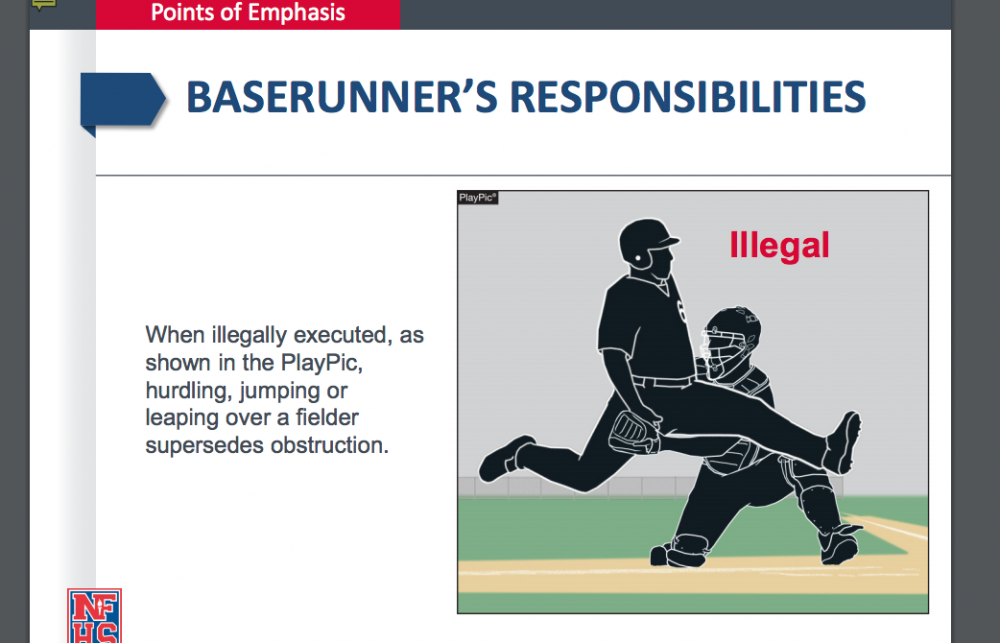
-
MU950 is the base shoe, not plate.
-
I've had the NB MU950 V2 for a little over a season now. All of a sudden, they are rubbing very hard on the back of my heels/bottom of achilles. Anyone else having this problem or have any suggestions to relieve the symptoms?
-
In the above interp, the timing of the P change is not specified as not reported or announced. The change becomes binding once recorded and announced by the chief-umpire. Pitcher warming up must face a batter at that point. However, if no such announcement is made, 3-1-1 states (as I believe the interp is leaning towards): "Should there be no announcement........a sub has entered the game when the ball is live and: (b) a P takes his position on the pitcher's plate." So, announce the change, or a storm is coming either way. A savvy coach could avoid an infraction on the pitch count after such error by just intentionally walking the next batter. (I do not believe this counts as 4 pitches thrown as is the case in LL)
-
Makes sense to me now. Very touchy situation. Hopefully both coaches appreciate the opportunity and handling of the situation to keep them in the game when it seems they both could have easily been gone.
-
The contact is were I see a major issue. If there was any contact with an official, he would be looking automatic ejection, plus a 4-game suspension. I'm having trouble seeing how it was unavoidable.
-
Agreed. I was essentially saying there was no cause to penalize the runner for doing what he was expected to do by rule, slide or no slide. The throw brought the C into a protected area, causing the incidental contact. Incidental being the key word, meaning no intent to interfere by the runner.

