All Activity
- Past hour
-
I did miss the "State adoption part. If I could delete, I would.
-
Is it, though? The 18” pizza box bases are an optional alternative. Instead, from the read, NJ is going all-in for compliance to the double base rule. My experienced estimate is that this (the inclusion of optional 18” bases) is a bone tossed to the schools / programs / venues / states that support a multitude of baseball levels conjunctively. Arizona high schools, especially those in Phoenix and Tucson, frequently play on fields that are part of or adjacent to OBR (Pro, et. al.) Baseball, which have largely eliminated the standard bases from their supplies. In fact, 3 of our 5 NAIA schools play on MLB/MiLB facilities, and are unable to support the double-first-base. Then back here in Wisconsin, there’s a complex near-&-dear to me that has 5 60-90 ball fields (1 Inde-pro stadium, 4 in a quad), with no less than 5 nearby school districts using their fields for Varsity baseball games. This complex also serves dozens of OBR and NFHS -based tournaments and leagues, as well as Adult Amateur. But again, it’s not only a physical facilities issue, but also a Human Resources / personnel issue. As we’ve discussed before, the kids that are playing OBR on the weekends are the very same kids playing for their high schools on Tuesdays and Fridays… with the same umpires in both environments!! This isn’t an excuse or “free-pass” to remain ignorant, unaware, or uneducated of rules (by umpires), but if a state weighs these costs against the benefits, and finds that the enlarged bases are the best optional compromise, then they should be able to adopt that. … and, finally, it appears NFHS is building that into it; certainly more obvious than the “it shall be navy” clause.
- Today
-
So glad they made this "rule" change to stop this play
-
Whats the cost of modifying the anchors for one base (double base) to modifying the anchors for three bases (18" bases)? Rhetorical question of course.
-
and NJ enters the realm of “ignoring new FED rules we don’t particularly like” See note under the memo 1
-
But the committee is not consistent. We (as a group) can’t learn the live balk rule, but the committee is certain all those “sub varsity lifers” are all going to know the double first base rule like the back of their hands.
-
That’s where the evidence comes from. The rare esoteric sit gets kicked. Even in MLB. We had a WP was killed. It didn’t help that the players also reacted as it was dead. I’ve had a clinic trained NCAA umpire tell me it was coach choice.
-
Yes. (even if there's an exception, this is a good way to think about it) Depends on the rules code. Always delayed in FED; sometimes delayed in OBR and NCAA In general this is correct, but the specifics depend on the rules code. For example, in FED, there's a minimum one base award form the location of the OBS. So, if the OBS was actually before second, (e.g., if F6 was standing on second and R1 had to slow down to approach) then the minimum award is second. In OBR, there's only a minimum award if the runner is being played on (and he's not in this scenario. And, the umpire should think of OBS as a *distance* (e.g., one or two strides) and must consider post-OBS play to determine the ruling. For example if F9 bobbles the ball and R1 now tries for home -- if he's out by only a stride or two, the umpire can award home; if he's out by "a lot" then the out stands.
-
what is a "turn towards third"? is it like an "attempt" like when you attempt to go to 2nd on an overthrow, and you only make a flinch motion with you shoulder etc. what exactly is a turn, and therein would lie the judgement point of any turn made, and therefor to be argued one way or the other and create a possible ejection situation due to the argument that ensues.
-
The committee is full of it. Major rule sets covered by amateur umpires and balks: NCAA - Delayed Dead Ball NAIA - Delayed Dead Ball NCBA (College Club) - Delayed Dead Ball NJCAA (Junior College) - Delayed Dead Ball NFHS - Dead ball Little League - Delayed Dead Ball American Legion - Delayed Dead Ball Babe Ruth - Delayed Dead Ball USSSA - Delayed Dead Ball Perfect Game tournaments - Delayed Dead Ball Pony Baseball - Delayed Dead Ball AABC (Connie Mack) - Delayed Dead Ball National Amateur Baseball Federation - Delayed Dead Ball If all these amateur umpires can handle delayed dead balls in every league from youth through college, I think high school umpires can be trusted with it.
-

Running Through 2B Standing - When is it abandonment?
DevildogUmp replied to Richvee's topic in Rules
Lindsay with CCS breaks it down: Basically, the updated rule interpretation is that replay can grab abandonment only if the runner is initially called out, replay reverse the out call, but the runner continues past the bag into the outfield. Because the call on the field was safe, this interpretation is not part of the conversation. -
FWIW, this is what my shoulder looked like after taking confirmed 96 uncaught. Yes I felt it. Yes i had to make sure my body was still intact, but limited bruising and little actual pain. YUP, I am referring to that almost unnoticeable red mark at the top of the shoulder.

-
Its delayed due to no play being directly made on the obstructed runner. This allows the defense to make plays on other runners and possibly record outs on them. It allows the obstructed runner to go past the base they would have been awarded. He is always a live runner and can commit interference and malicious contact during the play.
-

Running Through 2B Standing - When is it abandonment?
BLWizzRanger replied to Richvee's topic in Rules
Yeah, that is what I remember as the new rule. If they continued into left field, they would be considered abandoning the base. If they made the turn to third, they would be considered to be running the bases correctly. No one saw the 'return to second (or third if the force is there) immediately' in these scenarios. -

-
For the most part our sub varsity is wild west. Equipment is legal of course, but playing rules, pretty much whatever is decided. One of the best things we ever did was time limit the games thought. Nobody needs to see a JV game longer than 2 hrs.
-
I would agree with the committee that enough amateur umps could not, or would not want put the effort in, to comprehend the OBR balk rule. I only have anecdotal evidence though. That, among other things, would be umpire forums with posters adamantly espousing OBR balks and in the same thread getting the officiating of a sample situation wrong. Or the PONY umpire assignor from a South Texas city telling me that they use coach choice because the rule is too complicated. But NFHS did float a trial balloon to address the inequity of losing a HR and the possible reading comprehension skills of some of their cohort with using "coach choice", sadly convincing me, an avid rule guy, that that would not be bad. In my neck of the woods the JV coaches agree to whatever their players skill level is. We could have DH with first game free sub, all batting, 3 outs-3 runs, balk warnings with the frosh and competitive second game with guys that will be playing 6A V next year. Are there states that don't accommodate this?
- Yesterday
-
My thought is why you used “claim”. The umpires are correct and the “others” are not.
-
 3B Umpire Lance Barrett ejected Phillies infield coach Bobby Dickerson and HP Umpire Malachi Moore ejected pitching coach Caleb Cotham (Replay Review decision that confirmed 2B Umpire Mike Estabrook's safe / no abandonment call; QOCY) in the bottom of the 8th inning of the #Phillies-#Reds game. With one out and two on, Reds batter Sal Stewart hit a 3-2 sinker from Phillies pitcher Orion Kerkering on the ground to 3B Alec Bohm, who threw to 2B Bryson Stott, to 1B Bryce Harper, as Reds baserunner R1 Elly De La Cruz arrived at second base, ruled safe by 2B Umpire Estabrook and confirmed via Replay Review as the result of a manager's challenge by Phillies manager Don Mattingly. Replays indicate De La Cruz beat the throw to second base, overran second base, was not tagged, and returned to second base immediately after overrunning it, the call was correct.* At the time of the ejection, the Phillies were leading, 4-1. The Phillies ultimately won the contest, 4-1. This is Lance Barrett (94)'s 4th ejection of 2026.This is Malachi Moore (44)'s 1st ejection of 2026.*Official Baseball Rule 5.09(b)(2): "Any runner is out when after touching first base, they leave the base path, obviously abandoning their effort to touch the next base."MLB’s 2015 Change: "If a runner runs through 2B or 3B on a potential force play and is ruled out on the field, they can be called out for abandonment if they are ruled safe on instant replay but do not attempt to hold the base or advance to the next base."Enforcement: "Call may only be made by the Replay Official when a force out at second or third is overturned."Time Play: "If a time play occurs with a runner attempting to score from third base, the Replay Official will determine if the runner going home touched home plate before the abandoning runner passed the base (i.e., when their second foot touched the ground beyond the base)." These are the 64th and 65th ejection reports of the 2026 MLB regular season.This is the 11/12th coach ejection of 2026. Ejection Tally: 34 Managers, 12 Coaches, 20 Players.This is Philadelphia's 3/4th ejection of 2026, 1st in the NL East (PHI 4; MIA 3; NYM 2; ATL, WAS 1).This is Bobby Dickerson's 2nd ejection of 2026, 1st since June 30 (Cory Blaser; QOC = Y [Replay]).This is Caleb Cotham's first career MLB ejection.This is Lance Barrett's 4th ejection of 2026, 1st since May 30 (Brent Suter; QOC = U [Anthem Standoff]).This is Malachi Moore's 1st ejection since July 13, 2024 (Marcus Thames; QOC = N [Balls/Strikes]). Wrap: Philadelphia Phillies vs Cincinnati Reds, 7/7/26 | Video as follows: Alternate Link: MLB's "rules change" isn't even in the rulebook, but this isn't abandonmentView the full article
 -
Donny said to reporters after the game that the only reason it was argued was the fact the guy never made a turn towards 3rd base. He claimed they were shown video in Spring Training by MLB saying if the guy runs through the base and doesn't turn toward third, he can be called out. I would like to see the memo too..... https://www.nytimes.com/athletic/7430216/2026/07/08/phillies-coaches-tossed-reds-elly-de-la-cruz-second-base/
-
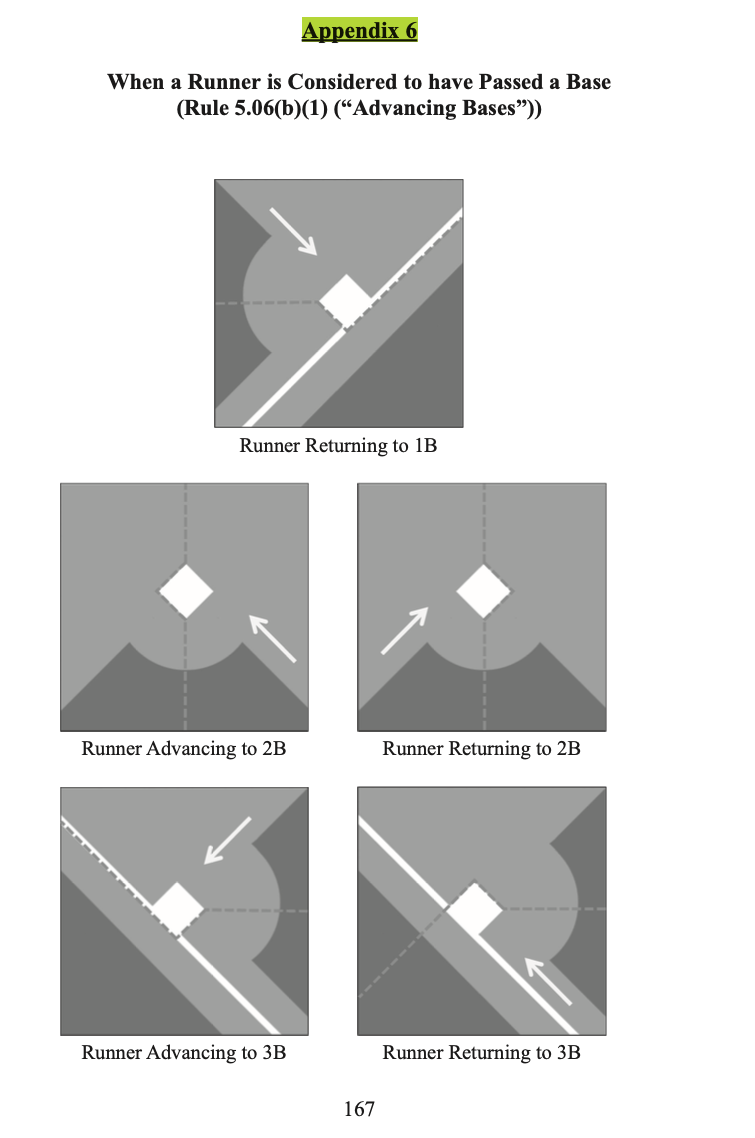
LLM conflagration of a play or overthinking it by "others". What base did the runner touch in between leaving and retouching 1B? How many steps short count? 1, 3 or 15? What if the runner is 5' tall or 7' tall? New OBR codifies when the runner has passed, and thus needs to retouch, a base.
-
Any thoughts on this? R1 going on the pitch. Fly ball to RF. Just as the runner approaches second base, he glances to see what’s happening with the batted ball. In doing so, he stops short of second base by a couple of steps. The RF catches the ball. R1 then turns to return to first base. In doing so, he does not touch 2nd base. When the ball is returned to the infield, 2B asks for the ball and properly appeals to the umpire that R1 did not touch second base. What's the call? Some umpires claim there can be no appeal because the runner never acquired or passed 2B. Others say that the runner should be out because he did not advance bases in order.
-
Exactly this. I used to be in the change it camp. Now, I'm 100% against changing it. There are far bigger fish to fry in the NFHS set.
-
And the committee would be correct.
-
Count MLB umpires in this group. Every now and then they screw this rule up. Most people don't like the NFHS rule because it "robbed" Johnny of a home run because the ball is immediately dead on a balk. Countless studies over the years have shown that the overwhelming number of NFHS balks don't involve a pitched ball that is even hit.