jimurrayalterego
-
Posts
871 -
Joined
-
Last visited
-
Days Won
18
1 Follower
.thumb.jpg.6dc4b62d5897857f93d53c1c3e9699a4.jpg)
jimurrayalterego's Achievements
496
Reputation
-
Does show where the pitched ball crosses strike zone at the middle of the plate. Which is why pitched balls that cross the strike zone at the front of the plate can be correct strikes for the ump but overturned on ABS. And the rare 12 to 6 curve that catches the back point of the plate can be a ball by ABS but a correct strike by the ump. That being said ABS is an improvement and correcting some gross misses.
-
Just some video to calm you down and keep that aneurism from bursting:
-
The 6.02(a)(1) cite is not for a start-stop of coming set. It's for start-stop of DELIVERY. The balk that Ceja probably called is from this restriction in 5.07(a)(2)......" from this position he shall go to his set position as defined in Rule 5.07(a)(2) without interruption and in one continuous motion." There is no penalty listed for violating that in 5.07(a)(2) and some violations of requirements in that rule are called "do not do thats" but this violation is called a balk as cited by Jim Evans as common practice. Stepping off while coming set is not illegal but I've seen MLB umpires perceive it as a start-stop. I agree with the crew chief reversal.
-
U3 called attention to time being out as R1 came into 3B. I don't think Hunter ever signaled it but somehow with relaxed action, other than Rodon's hissyfit, I guess time was assumed. Off topic, I have kicked dirt off the plate but does this speak to Hunter's physicality? Better clip than @Velho's for those that don't do FB: Adley Rutschman scores on passed ball | 08/29/2026 | MLB.com
-
Revisiting the thread due to this. Maybe time is automatic? https://www.facebook.com/share/v/1EDizB5S45/
-
They are rare but when they happen CCS never revises or acknowledges it.
-
CCS left out an important part of 5.02(a) "(a) The catcher shall station himself directly back of the plate. He may leave his position at any time to catch a pitch or make a play except that when the batter is being given an intentional base on balls, the catcher must stand with both feet within the lines of the catcher’s box until the ball leaves the pitcher’s hand. PENALTY: Balk." The balk for leaving the box during an IBB was rarely called back when pitches were thrown and MLB umpires were instructed to let the catcher leave the box at first motion. The catcher was also not guilty of CI by stepping on or in front of HP during a steal or squeeze. He stepped to the side as in a pitchout which is legal. "He may leave his position at any time........except........intentional base on balls."
-
I think MLB and NCAA do not want any part of the fielder in front of the base. NFHS allows part of the fielder in front of the base. I'm not sure you were aware of that difference.
-
Unless my reading comprehension has fallen favor to my dememtia, MLB and NCAA now do not want a fielder's body part to be in front of the base. NFHS allows it. Your disdain for NFHS is warranted to some degree but RTFM.
-
I think MLB ABS is in the middle also. CCS has some posts showing a strike overturned to ball on ABS where the ump doesn't get a missed call because the pitch was a strike at the front of the plate.
-
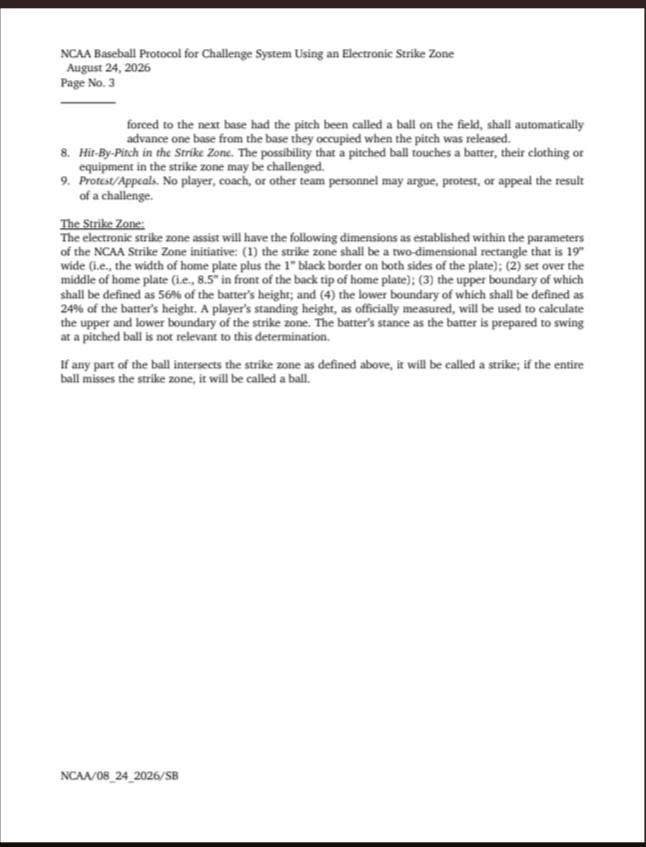
So the big money ADs will change the strike zone on ABS to 19". I suspect this will not be in the final edit. But it is an example of ....................
-
I don't think they are referencing Trackman. There might be some new Electronic Strike Zone system. It seems the Rules Committee wants a 19" wide zone where if any part of the ball intersects it will be a strike. Last I remember most NCAA baseball rules committees were composed of ADs and coaches.
-
ABS strike zone is 19". They want you to call the black bevel which is not visible? Reminds me of a high school coach who had his ground crew paint the bevel white and leave it showing.
-
Why we advise to mirror your partner's (competent type) balk call.
-
That becomes a problem when you learn 3-4 man. PU and U1, U2, U3 is intuitive. U1 at HP and U2 at 1B is not.