All Activity
- Past hour
-
I understand your thinking. But let's look at it from another perspective. How can you be sure what the coach is doing? In this situation, the umpire is going to get the dirty end of the stick if he accuses the coach of violating the rule without positive proof. If the umpire has positive proof, then, by all means, enforce the rule as written.
-
1. All Star Colbolt F3 or the Adams XV with an F3 harness 2. F3 shins. 14”. Nothing else works as well for me. 3. All Star FM4000MAG or Nike Icon with TW pads. 4. All Star Scully. Just started using it but I like it. 5. All Star cast 4 dial Indicator. Also functions as self defense tool. 6. Mizuno Plate shoes. Reebok FMs were the best. Why couldn’t Simittys copied these? 7. Jordan’s if the field is clean. 8. Diamond MMA or Nutty Buddy. I switch. I trust both. 9. EBags Mother Lode. 10. Oakley Flak Jacket XLJ with the field lenses I have all of the above (and more) as I am very fortunate. Admittedly have not dipped my toe into the newest GD gear. Missed out on the last custom Kuta. Waiting for the next release. I really feel we are in the golden age of equipment. We have a lot of options that we didn’t used to have.
-
We can argue all day about the strike zone. The most important element is, is the umpire consistent? Batters can adjust if an umpire is consistent. If the umpire is not consistent, then it's everyone for himself.
-
Unless I missed it, nobody has asked the most important question: Did a fielder have a reasonable chance to field the batted ball. Yes, runner is out. No. Then the ball is live and in play.
- Today
-
I figure this is coming at some point. I can’t imagine it’s that hard re:technology. Plate meeting we get handed an indicator that controls the board. Seems like everyone would be a fan of it.
- Yesterday
-
 Catuli joined the community
 -
Yes, sir. I was merely citing the speaker (singer?) of the words.
-
I want inside pitches that are not breaking balls to be closer to the plate.
-
So ... I'm posing some questions because there is very little consensus of how terms are used such as: ... Strike Zone ... Corner ... River ... White line ... Paint I call a lot of travel ball at a high level (PBR) and unless we are calling the top of the top level, we call strikes for pitches that are up to but not touching the white lines (batter's boxes). For those counting at home, that is a precise width of 29". River (6") + plate (17") + River (6"). If you call just the plate, just the WHITE, and you call a strike for anything "painting" the white, that's a width of about 23" outside to outside of the ball. If you use the black, add 2 inches. When a batter asks, "Blue, was that the corner?" I am saying YES if the outside of the ball was painting the batter's box. When a batter asks if that painted the zone, I only say yes if it painted the plate. I would appreciate any discussions on the true width of zones you call. Even for Varsity HS, I would guess my zone is 27" wide from outside to outside of the ball. This came from a widely shared video produced by FED.
-
So ... I'm posing some questions because there is very little consensus of how terms are used such as: ... Strike Zone ... Corner ... River ... White line ... Paint I call a lot of travel ball at a high level (PBR) and unless we are calling the top of the top level, we call strikes for pitches that are up to but not touching the white lines (batter's boxes). For those counting at home, that is a precise width of 29". River (6") + plate (17") + River (6"). If you call just the plate, just the WHITE, and you call a strike for anything "painting" the white, that's a width of about 23" outside to outside of the ball. If you use the black, add 2 inches. When a batter asks, "Blue, was that the corner?" I am saying YES if the outside of the ball was painting the batter's box. When a batter asks if that painted the zone, I only say yes if it painted the plate. I would appreciate any discussions on the true width of zones you call. Even for Varsity HS, I would guess my zone is 27" wide from outside to outside of the ball. This came from a widely shared video produced by FED.
-
I'm shocked @Richvee didn't catch this before me. Neil Peart wrote those words of wisdom.
-
Agreed. How often do we see 1bc / 3bc "filed" a foul ball? That's never called INT. I know NCAA used to have a rule that if the BR contacted a foul ball, he was out. They then changed it mabe 15 years a go to "the ball must have a chance to become fair." I don't think there's anything directly on this, but if there's no play, there's no interference.
-
Do we have anything in baseball like the below from USA Softball Rulebook? 33-A "If, in the judgment of the umpire, the foul fly ball could not have been caught with ordinary effort, a strike is called, the ball is dead, and the batter remains at bat." 33-D " If interference occurs by the runner on a foul fly ball not caught but, in the umpire’s judgment, could have been caught with ordinary effort had interference not occurred, the runner is out and the batter is also out. If, in the judgment of the umpire, the foul fly ball could not have been caught with ordinary effort, a strike is called, the ball is dead, and the batter remains at bat."
-
Here's the thing, @The Man in Blue... on this play in the original post, there's INT. The Batter popped the ball into the air, and hindered – whether intentional or not, in this case, is irrelevant... in this case – the fielder's attempt to catch it. There. Call INT, Batter is out, move on to the next. Done. On the proposed variation of play, in which the batted ball hits the ground, is where I interject my skepticism, cynicism, and criticism (yup! All three -isms!). My issue isn't with the rule per se, it's with the imperative – "We must call INT...". If a batted ball is obviously foul, and the BR sprints out of the box, up the line, and contacts the F1 who's reactively headed towards that batted (foul) ball, are we calling OBS and awarding BR 1B?? In that same vein, say we have a batted ball that is headed towards and ultimately into the stands... are we calling INT on the 1BC for contacting / impeding the F3 at the moment the ball left the bat? No, that would be absurd. We observe INT occurring, and we apply the penalty if warranted, but we – here's the big part – determine where the ball ultimately goes, and if the INT affected / changed that outcome. If we didn't do this, then that incentivizes one of the two parties to engage in these... contestations... so as to draw a call. If the imperative exists, then you better believe that a F1 will "steer towards" a BR on any batted (ground) ball in the vicinity of home plate or up the 1BL, regardless of it being Fair or Foul. We see eerily similar antics with Runners steering / going out of their way so as to draw an OBS call (typically during a rundown). So, on this proposed play, I've got this ball going definitely Foul. And in my judgement, that outcome is unaffected by any/the contact that occurred between BR and F5. I completely agree, that if the batted ball's status is still undeterminable – ie. "maybe" – with a chance of being / ending Fair, and the ("protected") fielder has that opportunity to make it Fair, we should call and apply INT.
-
@dumbdumb, we should know by now that the Professional game (uppercase P) is an entirely different environment and set of protocols, expectations, and morés than most of us will ever experience.
-
 Can you expand on this? Not sure I follow.
 -
Need to add Belt- Pioneer Belt, patent or regular, gold or silver buckle. They make their belts with the holes in 1/2" increments so those hot days you can tighten it in the later innings, and if you are bundled up with multiple garments tucked in you can let it out a half. lifetime warranty (and we KNOW umpires like wearing the same thing for a lifetime!! 😄). Family owned company. USA made. Get one, you wont be disappointed.
- Last week
-
Staying the way of the batted ball and getting hit by it definitely is INT. I object to NFHS adding that statement as it applies to vacating a base for a fielder. Standing still, as long as it is not in the path of the ball is reasonable.
-
 I'll take another approach. F5 was not moving with the urgency of making a play, meaning "no potential out." No play/potential out = no potential interference. Maybe I am taking that approach because of a long-standing opinion of mine: "unintentional interference" that creates a play for the offense is preventing the defense from ending the play, and should be treated as such. If you want to rule no interference on this and allow it to stand, then do NOT allow it to extend the play or create a new play (R2 scoring and BR advancing to second).
 -
I still do not understand why Marmol is so loved in St. Louis.
-
Looks like there was even a thread here! I see some improvements I would make, but that is the concept.
-
Robin Williams' best movie, IMHO. And no offense taken. If I can think harshly about the Reebok Magistrates, you can think harshly about those Mizunos.
-
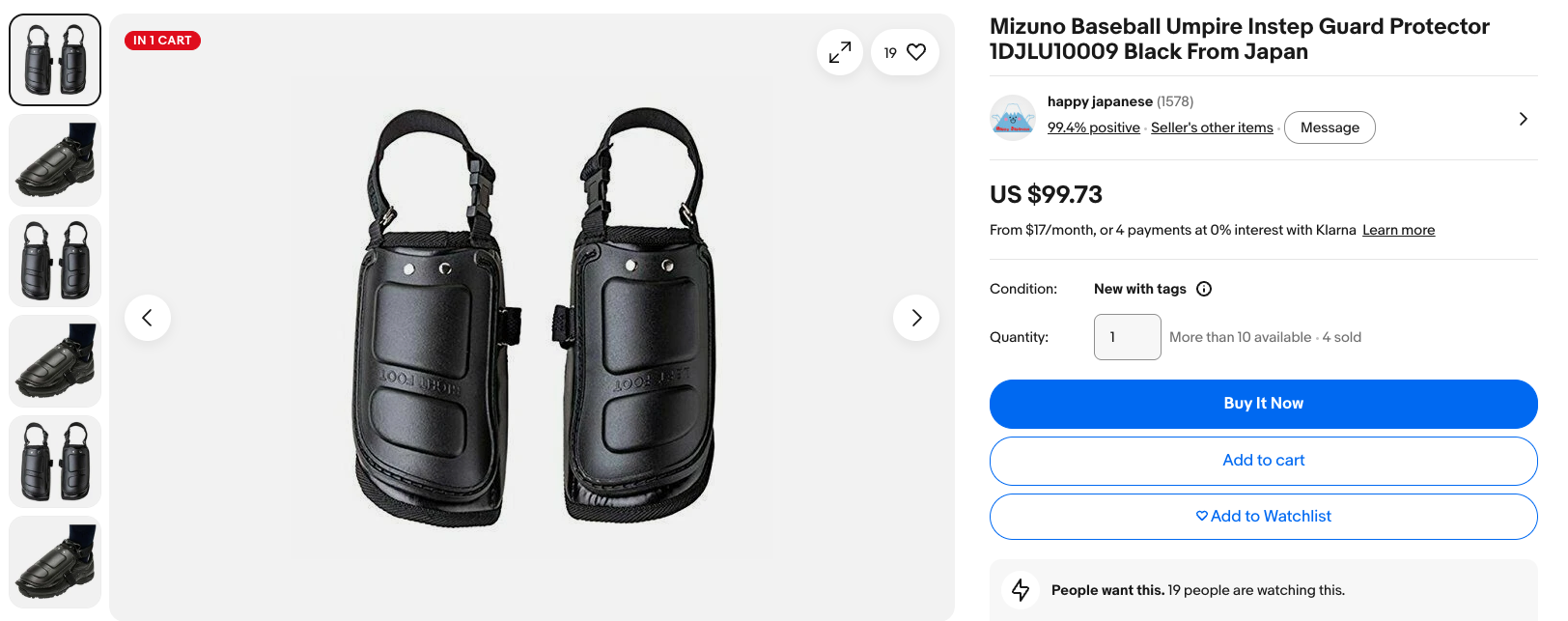
Mizuno Japan beat you to it, TMiB.
-
Maybe I'm missing something. I am saying from 60 feet and 6 inches away, with him standing on a hill, if he looks like he is touching, he is touching as far as I am concerned. I'm making that call. I'm willing to get with my partner afterwards, but I'm not parsing whether he was touching it on a sub-atomic level.
-
This has been my exact thought process. The goal shouldn't be to design a shoe, but to design the protection for the shoe.