Stk004
-
Posts
2,192 -
Joined
-
Last visited
-
Days Won
30
Everything posted by Stk004
-

-
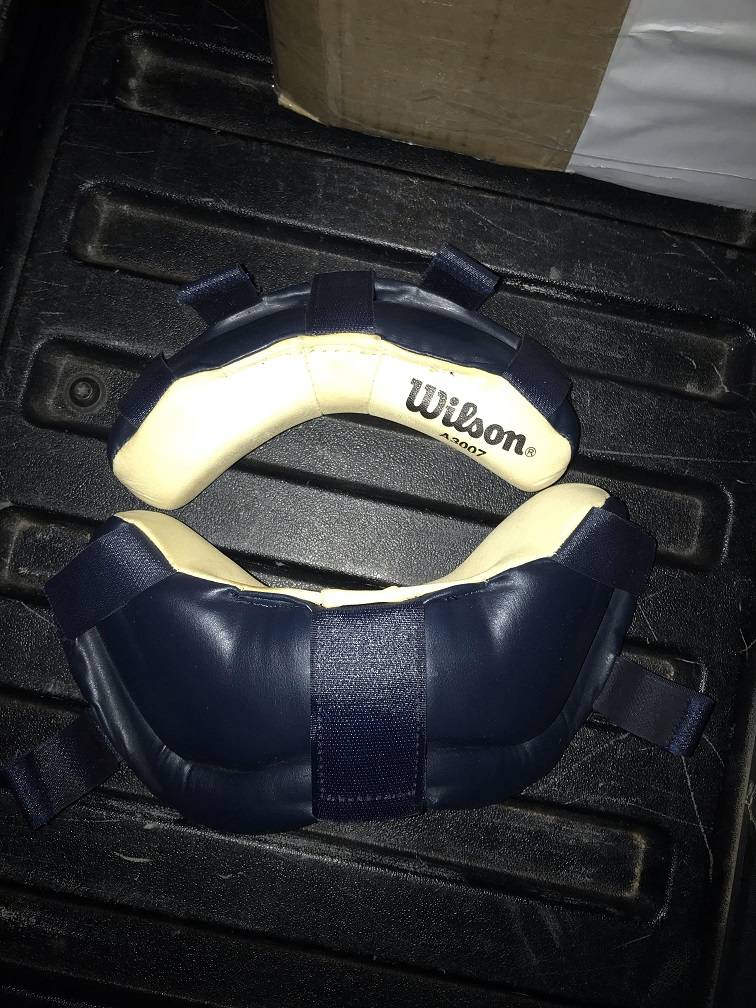
I have some navy/blue mask pads I would like to sell. Both appear to be brand new. The first set is navy/tan Wilson wraparounds. The second is royal blue Adidas pads. I don't have any navy shirts to wear with them so I figured someone else could put them to use. Asking $25 each. PM with any questions/inquiries. I would also be open to a trade for tan/brown Wilson pads, preferably wraparounds. I have another post relating to this.


-
Does anyone else think this is a Nike steel?
-
Hi everyone, I'm looking to acquire a set of tan or brown pads. Something along the lines of all tan or brown Wilson pads (wraparound preferred) or reasonably priced Belgards or something. Brown might be better than tan for my purposes but either is fine. Side note, I'm not a fan of Honig's calfskin pads. More important side note: I have NAVY and tan Wilson wraparounds and blue Adidas pads I would like to sell or trade. If anyone has an interest in these let me know and we can work out a trade.
-
I don't have my FED rule book with me right now but it's interference, the batter is out, and runners return. Here's the relevant comment from OBR. If someone finds the FED equivalent that'd be awesome.
-
I'd never even thought of this....
-
I've posted this play a bunch on this forum but it's a good one. U1 (Barksdale) calls interference once it happens. Notice, however, he doesn't call time immediately. He waits for the ball to be touched (in this case caught) before making his decision. You can see the gears turning. He calls the runner out then decides that since the ball is fair the batter will be awarded first base. Had the ball been foul, the batter would go back to the plate.
-
Two separate questions. 1. What happens if the ball is fair (caught or otherwise)? 2. What happens if the ball is caught in foul territory? 1. If the ball is fair, we now have IFF so the batter is out. We also have interference on R1, so he's out as well. In this case we have two outs. 2. If the ball is caught in foul territory we do not have IFF, so the batter is not out. R1 is called out for interference, batter returns to the plate with a strike added just as he did in the OP.
-
The ball landed and rolled foul untouched, correct? So we don't have an infield fly because the ball was not fair. We do, however, have interference on R1. Since the ball was foul, R1 is out for interference and the batter returns to the plate with a strike added (unless there was already two strikes).
-
If U1 is going out and it's a fly ball (not a line drive requiring a F/F decision), I'm assuming runners are looking to tag. If the fielder botches it or misses a diving catch I'd stay home and let U3 take the bases. Also it's standard for PU to stay home with R1 and R3 (aka no first to third rotation in this situation) so this shouldn't change based on U1 going out.
-
I would call time to eliminate any confusion and to prevent the defense from throwing the ball around. "Time, stay there" is what I would say before talking to my partner. You're 95% certain the runner is going to stay at second, so I think it looks better if they're at second base the entire time rather than going back and forth.
-
It appears nobody in this thread has really explained what "timing" is. Sure, we all know we need to slow down our timing, but that doesn't mean simply holding off on our call for an extra 2 seconds. If you're still deciding on the pitch before it even gets to the plate, nothing will change. Timing is created by proper use of eyes. This means watching the ball from the pitcher's hand all the way into the catcher's glove AND THEN deciding if it's a ball or a strike. Do not make up your mind until the catcher catches it. Once the ball is securely in his glove, think "okay, ball or strike?" Once you make up your mind, come up and call it. This is the best way to have good consistent timing. A lot of people (not necessarily on this board but in general) use artificial timing. Meaning the pitch comes in and they think "wait, wait wait, okay call it." Meanwhile they've already made up their mind. You shouldn't wait to call a pitch for no reason. The delay you see should be you thinking about the pitch. Some guys will take forever to actually signal, giving the impression that they're tracking the pitch. Others will verbally call it once the ball hits the glove, then delay their mechanic to give the impression of proper timing. These artificial tricks won't improve your zone and is not the way to establish good timing.
-
Okay, I think I'm ready to provide an answer to this situation. @Senor Azul , what is "Deary" in the OBR interp, out of curiosity? I'm going to talk in terms of OBR. I realize the OP and the video are Fed, and while I'm familiar with Fed rules, I'm much more comfortable and familiar using OBR. If anyone finds something that explicitly goes against what I say in the Fed book, please let me know. The way I see it, there's two possible arguments for interference. First, a runner (who has already scored) being touched by a fair batted ball. Second, a runner that has just scored interferes with the defense (namely F2) making a play on another runner. 1. There's nothing in OBR about a runner that has just scored being touched by a fair batted ball. OBR 5.09(b)(7) says that a runner is out for interference when he is touched by a fair ball in fair territory. However, in our scenario the runner has already scored, so HE cannot be called out for being touched by a fair batted ball. This rule does not provide for the batter being called out for a runner being touched by a fair ball (In fact, "normally" the batter is awarded first base), so we cannot have any outs for interference based on this rule. 2. OBR 6.01(a)(5) says it is interference by a batter or runner when any batter or runner who has just been put out, or any runner who has just scored, hinders or impedes any following play being made on a runner. Such runner shall be declared out for the interference of his teammate. This is a very valid argument. F2 was undoubtedly hindered by R3 deflecting the ball away from where it would have otherwise hit the ground. Until the last year or so, I would say the batter runner should be called out for the interference of his teammate (R3) under this rule, specifically for hindering the defense's ability to make a play. HOWEVER, MLB has made it painstakingly obvious that the comment to this rule shall be strictly followed. It states: Rule 6.01(a )(5) Comment: If the batter or a runner continues to advance or returns or attempts to return to his last legally touched base after he has been put out, he shall not by that act alone be considered as confusing, hindering or impeding the fielders. R3 was simply continuing to advance by sliding, and he did nothing else to constitute interference. Based on this comment, and MLB's strict enforcement of the comment, we cannot call interference based on this rule either. As a result, I have no interference by R3, allowing R3 to score and the defense and the batter runner should play on.
-
I am too. My initial instinct says "fair ball, play on" but then I thought "this would probably be interference," so honestly I don't know off the top of my head. @Doug63 , what actually happened on the field?
-
The runner has already scored though, hasn't he?
-
The only legal way to step off (disengage) the rubber is by stepping backwards. The pitcher is allowed to move his pivot foot towards third base before completing the pickoff, but he must throw to first base. That and a jump turn are both considered moves from the rubber, so he has to throw to first base.
-
Why wait until he crosses the plate? You can eject him immediately and he can still run the bases.
-
This is exactly right. I like to wear my mask loose enough where I can push down on the chin guard and have my mask come off my head easily. This way I know if I get hit on the bottom of the mask it should come off easily instead of being driven into my chin. Obviously you want it tight enough so the mask stays on your head, but I'd be uncomfortable knowing it would take a large amount of force to knock my mask off.
-
Once the pitcher starts his motion from the windup, he has to deliver a pitch to the plate. So if he's committed to the plate as soon as he starts his motion, why would he have to come set?
-
Only 6 available and the leather pads still have the ABS plate.
-
Honestly not as expensive as I thought.
-
What size of Chicago screws will you use?