Leaderboard


Popular Content
Showing content with the highest reputation on 01/29/2023 in all areas
-
Ordered 2 for $81 with free shipping! https://www.joesnewbalanceoutlet.com/pd/460v3-low-umpire-plate/MUL460V3-34693.html#dwvar_MUL460V3-34693_style=MUL460T3&dwvar_MUL460V3-34693_width=D&pid=MUL460V3-34693&quantity=12 points
-
Alright, we're now at a point where this needs to be asked... If I was to purchase one of these RefSmart timers new, today, what intervals would it have? 120/20, with a 10 second "thump"? Is NCAA Division I (and select Division II) giving a BU an altogether different device that controls the in-park clock display, or is this RefSmart box able to transmit to a receiver linked to the in-park clock display? Is professional (OBR) baseball implementing 120/20 with a 5 second "thump"? If so, how is that being timed, ie. does it involve the RefSmart timer? How? Is this the "original" model? I'm trying to avoid being compelled to purchase two different models. In the meantime, I'm sticking with my stopwatch (see above post), and figuring that for the Minor League Spring Training events I do find myself in, there's not going to be strict observance / adherence to the 120/20 - 5(?) rule. High School? I have no idea how they're going to implement it, so I'll stumble across that bridge as it's being built.1 point
-
No I am about an hour from St. Louis. Small town called Auxvasse1 point
-
Looks like the Post Office missed a scan on my timer. I checked today and not only did it arrive Friday, it's done and shipped out to be here Monday. That's great service. From promptly answering my email and re sending a label, to the turnaround time in reprogramming and shipping back.1 point
-
I'm sorry for the delayed response...I missed the question and just revisited this thread. I'm in Ohio and tested for our state athletic association. It was a three part test. 50 questions each. Part 1 was basically test on organization overview regarding their standards etc. Part 2 was Rules Part 3 was Scenarios and Mechanics1 point
-
This is either gonna be a really cool innovation or the next ridiculous thing NFHS starts wheezing about to us lol1 point
-
I use the AS one..
 1 point
 -
I wear the SG shovel.
 1 point
 -
The following case play can be found in the 2016 BRD (section 296, p. 197): Play 161-296: R1. The runner is moving on the pitch when B1’s attempted bunt is a pop-up behind the plate. BR heads for first as the foul is caught. The catcher throws to F3 to double up R1, but his throw hits BR in the running lane and goes into the dugout. Ruling: R1 is awarded third. BR was in the running lane; that he continued to run is not sufficient to create interference. Note 267: If BR had been to the left or right of the lane, the umpire would properly call out R1 because of interference by a retired batter-runner. BRD comment: If R1 does not retouch first before he touches second on the award, on proper appeal he will be out. Our guest Tom only identified his scenario as a “12 year old game” with no word as to what rules governed his game. He also did not give us any details as to whether the batter-runner actually interfered in any way on the catcher’s throw to first. So here’s a FED interpretation that tells us that it does matter if the batter-runner is following the baserunning rules-- From the 2016 BRD (section 349, p. 232): FED Official Interpretation: Rumble: R1, one out. B1 strikes out, but F2 drops the ball. BR starts for first, and the catcher’s throw hits him: (a) inside the running lane; or (b) not in the running lane. Ruling: in (a), there is no interference unless BR deliberately got hit by the ball. The ball remains alive. In (b), BR is guilty of interference. The ball is dead, and he is declared out. R1 returns TOP unless he had reached second at the time of the interference. Note 325: Don’t be confused by the OI. The batter is declared out: he was out the moment he swung for strike three. In (a), he’s inside the lane so there’s no additional penalty: R1 might go on to third. The point: The catcher should have known not to play on BR. But in (b), BR is out of the lane: His interference kills the ball and prevents R1 from advancing. From the 2016 BRD (section 349, p. 233): OBR Official Interpretation: Wendelstedt: Interference may be called on a batter-runner who is already out if he interferes with a play being made back into first while he is outside of the running lane. The runner on whom the play is being made (R1) is out.1 point
-
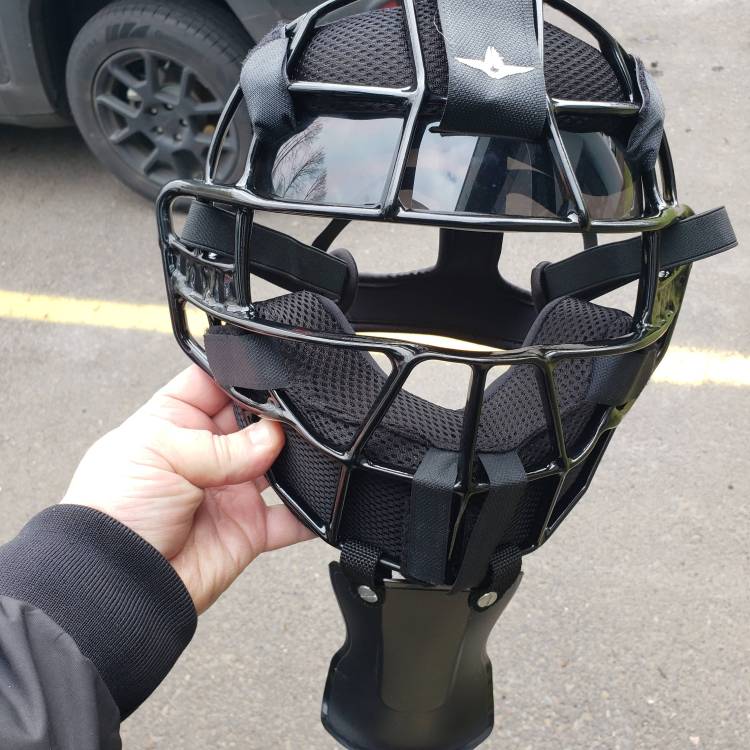
Of course im cheating a bit since I got my mask after it was cut
 0 points