All Activity
- Past hour
-

-
For the most part our sub varsity is wild west. Equipment is legal of course, but playing rules, pretty much whatever is decided. One of the best things we ever did was time limit the games thought. Nobody needs to see a JV game longer than 2 hrs.
-
I would agree with the committee that enough amateur umps could not, or would not want put the effort in, to comprehend the OBR balk rule. I only have anecdotal evidence though. That, among other things, would be umpire forums with posters adamantly espousing OBR balks and in the same thread getting the officiating of a sample situation wrong. Or the PONY umpire assignor from a South Texas city telling me that they use coach choice because the rule is too complicated. But NFHS did float a trial balloon to address the inequity of losing a HR and the possible reading comprehension skills of some of their cohort with using "coach choice", sadly convincing me, an avid rule guy, that that would not be bad. In my neck of the woods the JV coaches agree to whatever their players skill level is. We could have DH with first game free sub, all batting, 3 outs-3 runs, balk warnings with the frosh and competitive second game with guys that will be playing 6A V next year. Are there states that don't accommodate this?
- Yesterday
-
My thought is why you used “claim”. The umpires are correct and the “others” are not.
-
Donny said to reporters after the game that the only reason it was argued was the fact the guy never made a turn towards 3rd base. He claimed they were shown video in Spring Training by MLB saying if the guy runs through the base and doesn't turn toward third, he can be called out. I would like to see the memo too..... https://www.nytimes.com/athletic/7430216/2026/07/08/phillies-coaches-tossed-reds-elly-de-la-cruz-second-base/
-
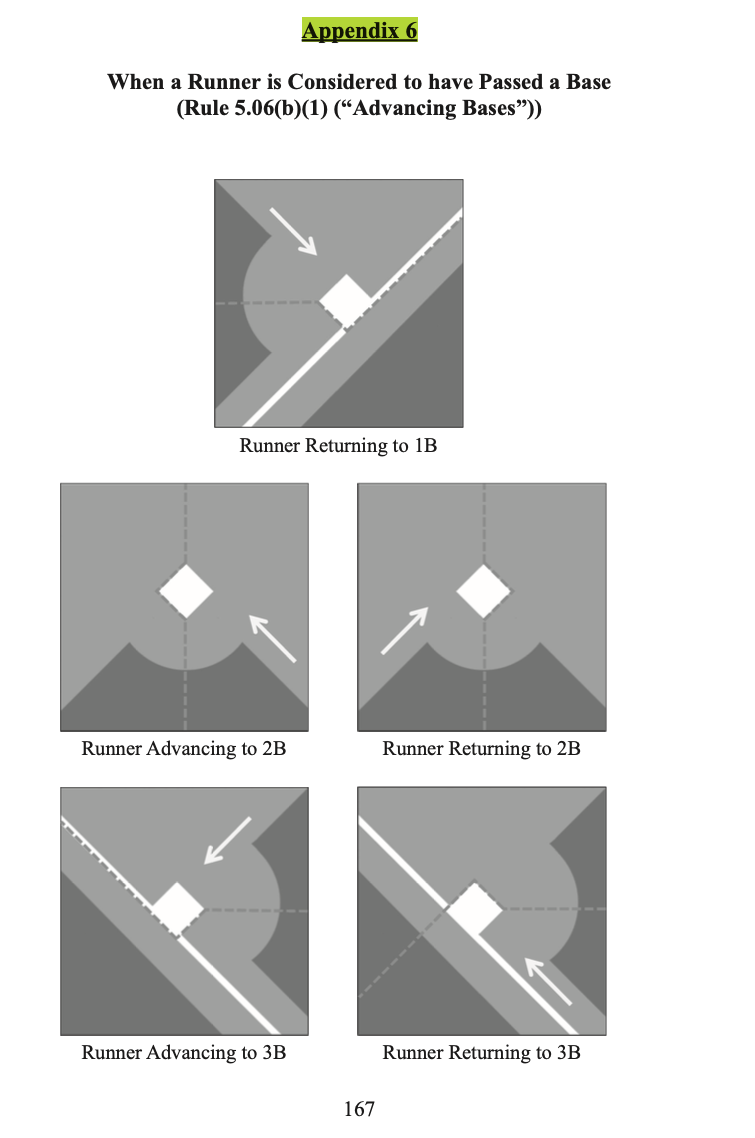
LLM conflagration of a play or overthinking it by "others". What base did the runner touch in between leaving and retouching 1B? How many steps short count? 1, 3 or 15? What if the runner is 5' tall or 7' tall? New OBR codifies when the runner has passed, and thus needs to retouch, a base.
-
Any thoughts on this? R1 going on the pitch. Fly ball to RF. Just as the runner approaches second base, he glances to see what’s happening with the batted ball. In doing so, he stops short of second base by a couple of steps. The RF catches the ball. R1 then turns to return to first base. In doing so, he does not touch 2nd base. When the ball is returned to the infield, 2B asks for the ball and properly appeals to the umpire that R1 did not touch second base. What's the call? Some umpires claim there can be no appeal because the runner never acquired or passed 2B. Others say that the runner should be out because he did not advance bases in order.
-
Exactly this. I used to be in the change it camp. Now, I'm 100% against changing it. There are far bigger fish to fry in the NFHS set.
-
And the committee would be correct.
-
Count MLB umpires in this group. Every now and then they screw this rule up. Most people don't like the NFHS rule because it "robbed" Johnny of a home run because the ball is immediately dead on a balk. Countless studies over the years have shown that the overwhelming number of NFHS balks don't involve a pitched ball that is even hit.
-
We already do/did in Arizona, where Sub-varsity games have a time limit, we don't keep an action clock (by the umpires), and a few other details. If you're speaking about wholesale rule changes / adaptations, you're not going to see it from NFHS itself. Why? Because the NFHS rules are largely influenced by liability concerns, not "fair, competitive playability". Then, there are a few antiquated "holdout" rules, kept there by (a) committee member(s) who for any number of reasons, personally endorses that rule, and fiercely defends it, ala Charleton Heston, "From my cold, dead hands." The one that comes to mind is the Balks as Live rule, wherein some part of the committee felt – without any concrete or measurable evidence – felt that we amateur umpires could not properly adjudicate a balk. Sub-varsity should actually be conducted like a structured scrimmage, with the latitude to "roll an inning", less stringency on Balks, run a continuous batting order and allow for defensive (non-pitcher) substitutions.
-
Do you think we’ll ever get to the point where FED opens its eyes and distinguishes varsity from sub varsity? At least around here, except for a few outliers, sub varsity is almost rec ball. Keep your little league bats, dead ball balls down there. Let the varsity play baseball
-
Looking forward to those 15-14 three hour thrillers.
-
Drop 6 bats in high school?
-

-
It's only FED that lets the umpire assume a DP and call two outs. OBR, NCAA the interference must be judged intentional to break up a double play in order to call 2 outs.
-
It is an immediate dead ball. In that scenario, the umpire could rule two runners out. Specifics on what merits the double play vary by rule code (MLB, NCAA, NFHS, Little League).
-
This is what I mean. I doubt the change actually says “The rule change gives umpires the power to call the trail runner out for abandonment of second base even if he beat the throw. He is considered to have abandoned the bag as soon as both feet land on the other side of the base “ There’s no way that’s the rule. That’s some writers uneducated take. Would love to see the actual memo
-
Beginning next year, high school baseball teams will be given the option to use an 18-inch first base or the double first base. The larger base is presented as an alternative to the previously mandated double first base, which goes into effect in 2027. The larger first base option was one of seven rules changes recommended by the NFHS Baseball Rules Committee at its meeting last month in Indianapolis and which were subsequently approved by the NFHS Rules Review Committee and NFHS Board of Directors. In conjunction with the double first base, allowing a larger first base has proven to be effective in reducing player collisions and enhancing player safety. “The NFHS Baseball Rules Committee believes that providing schools with the option of using either an 18-inch first base or a double first base gives administrators the flexibility to enhance player safety while recognizing the varying needs and resources of member schools,” said Elliot Hopkins, director of sports and liaison to the NFHS Baseball Rules Committee. “Both options are designed to reduce the potential for collisions at first base and support a reduced risk playing environment without changing the fundamental nature of the game." One-way electronic communication will now be allowed from the coach to the pitcher and/or the catcher for the purposes of calling pitches. Prior, the catcher was the only defensive player allowed to receive communication from the coach. While the coach must still be located in the dugout/bench area, the committee believes this change responsibly integrates electronic communication that enhances game management. Bat certification was addressed with USA Baseball assuming bat-testing standards. Effective in 2028, there will be an additional class of permitted non-wood bats. Bats that are not made of a single piece of wood shall meet either the USA Baseball Batted Ball Coefficient of Restitution (USA Baseball BBCOR) of .50 or the USA Baseball Bat Performance Standard (-4, -5, -6). Bats must be labeled with a silkscreen or other permanent certification mark. “In addition, the NFHS remains committed to fostering the growth and development of high school baseball players,” Hopkins said. “As the game continues to evolve with the adoption of the USA Baseball BBCOR standard, expanding the available drop-weight options provides younger and developing players with additional opportunities to build proper mechanics, confidence and skills while maintaining the safety and performance standards expected in education-based athletics.” Additional rules changes include: Eye shade must be a solid stroke and not include words, numbers, logos or other symbols within the eye shade. Use of electronic communication devices by players on the field is prohibited (except as outlined with one-way coach to player communication). This includes amplifying devices, wireless communication devices, headphones, etc., for the purposes of recording, streaming or transmitting audio or video. The prohibition does not include medical devices. Coaches will be allowed to use a handheld electronic scoring device or other scoring material while in the coach’s box. When using a tiebreaker to end a regulation game, an option is now available to start each half-inning with a runner on second base. The runner would be the last scheduled batter in that respective half-inning.
-
I don't see any applicable OBR changes (though the new 2026 5.06(b)(1) language on when a base is passed could be Interpreted in deciding Abandonment. Story on "rule change" https://www.mlb.com/news/mlb-shift-baserunning-rules-changes-2025 History for those not aware https://www.mlb.com/news/running-through-second-base-trend I saw an uncalled similar MLB play a week or two ago.
-
Closest I can see is 5.09(b)(2) and the comment. It specifically talks about first base, but the language ", he leaves the base path, obviously abandoning his effort to touch the next base" leads me to feel like it could be upheld on other bases as well. I was watching the game. It felt like he was believing he'd be out on the force and pealed off. He came right back, though, as soon as he realized the safe call. The Philly announcers were thinking interference, but there was nothing there either. Donny Baseball probably wouldn't have made a fuss if Orion wasn't throwing grapefruits. At least Leslie gets another 2 fer ejection video out of it.
-
Reds / Phillies last night. DeLa Cruz runs though 2B on a force, he's safe, Phillies want abandonment. I'm have trouble finding the actual wording of the rule change this year. All I find is AI generated results, or reporters opinions paraphrasing the rule. I can't find the direct rule from MLB... The rulebook or elsewhere... Help.
-
A). Are all "defensive interference" plays called "obstruction"..?? Whereas most offensive interference plays are called "interference"...?? (I suppose except "catcher's interference" or "umpire's interference") B). Are all obstruction penalties by the defense a delayed call by the umpire? Or are any obstruction calls an immediate dead ball..?? C). Scenario: runner on 1st, base hit into the outfield: the baserunner as he's rounding second is obstructed by the shortstop covering the second base bag with no incoming throw. This is a delayed call/runner is awarded third base. It's delayed because the baserunner may choose to round third base, and if so, the delayed call is erased, and he is then a live runner..... is all this correct..??
-
-
FWIW: worked a couple games this past weekend with a colleague (with JuCo experience) who bought the Enduro after seeing mine (moved to the Enduro from the Wilson Platinum). He took a hard foul directly off the CP and was impressed with how little he felt.