All Activity
- Past hour
-
Do we have anything in baseball like the below from USA Softball Rulebook? 33-A "If, in the judgment of the umpire, the foul fly ball could not have been caught with ordinary effort, a strike is called, the ball is dead, and the batter remains at bat." 33-D " If interference occurs by the runner on a foul fly ball not caught but, in the umpire’s judgment, could have been caught with ordinary effort had interference not occurred, the runner is out and the batter is also out. If, in the judgment of the umpire, the foul fly ball could not have been caught with ordinary effort, a strike is called, the ball is dead, and the batter remains at bat."
- Today
-
Here's the thing, @The Man in Blue... on this play in the original post, there's INT. The Batter popped the ball into the air, and hindered – whether intentional or not, in this case, is irrelevant... in this case – the fielder's attempt to catch it. There. Call INT, Batter is out, move on to the next. Done. On the proposed variation of play, in which the batted ball hits the ground, is where I interject my skepticism, cynicism, and criticism (yup! All three -isms!). My issue isn't with the rule per se, it's with the imperative – "We must call INT...". If a batted ball is obviously foul, and the BR sprints out of the box, up the line, and contacts the F1 who's reactively headed towards that batted (foul) ball, are we calling OBS and awarding BR 1B?? In that same vein, say we have a batted ball that is headed towards and ultimately into the stands... are we calling INT on the 1BC for contacting / impeding the F3 at the moment the ball left the bat? No, that would be absurd. We observe INT occurring, and we apply the penalty if warranted, but we – here's the big part – determine where the ball ultimately goes, and if the INT affected / changed that outcome. If we didn't do this, then that incentivizes one of the two parties to engage in these... contestations... so as to draw a call. If the imperative exists, then you better believe that a F1 will "steer towards" a BR on any batted (ground) ball in the vicinity of home plate or up the 1BL, regardless of it being Fair or Foul. We see eerily similar antics with Runners steering / going out of their way so as to draw an OBS call (typically during a rundown). So, on this proposed play, I've got this ball going definitely Foul. And in my judgement, that outcome is unaffected by any/the contact that occurred between BR and F5. I completely agree, that if the batted ball's status is still undeterminable – ie. "maybe" – with a chance of being / ending Fair, and the ("protected") fielder has that opportunity to make it Fair, we should call and apply INT.
-
@dumbdumb, we should know by now that the Professional game (uppercase P) is an entirely different environment and set of protocols, expectations, and morés than most of us will ever experience.
-
 Can you expand on this? Not sure I follow.
 -
Need to add Belt- Pioneer Belt, patent or regular, gold or silver buckle. They make their belts with the holes in 1/2" increments so those hot days you can tighten it in the later innings, and if you are bundled up with multiple garments tucked in you can let it out a half. lifetime warranty (and we KNOW umpires like wearing the same thing for a lifetime!! 😄). Family owned company. USA made. Get one, you wont be disappointed.
- Yesterday
-
Staying the way of the batted ball and getting hit by it definitely is INT. I object to NFHS adding that statement as it applies to vacating a base for a fielder. Standing still, as long as it is not in the path of the ball is reasonable.
-
 I'll take another approach. F5 was not moving with the urgency of making a play, meaning "no potential out." No play/potential out = no potential interference. Maybe I am taking that approach because of a long-standing opinion of mine: "unintentional interference" that creates a play for the offense is preventing the defense from ending the play, and should be treated as such. If you want to rule no interference on this and allow it to stand, then do NOT allow it to extend the play or create a new play (R2 scoring and BR advancing to second).
 -
I still do not understand why Marmol is so loved in St. Louis.
-
Looks like there was even a thread here! I see some improvements I would make, but that is the concept.
-
Robin Williams' best movie, IMHO. And no offense taken. If I can think harshly about the Reebok Magistrates, you can think harshly about those Mizunos.
-
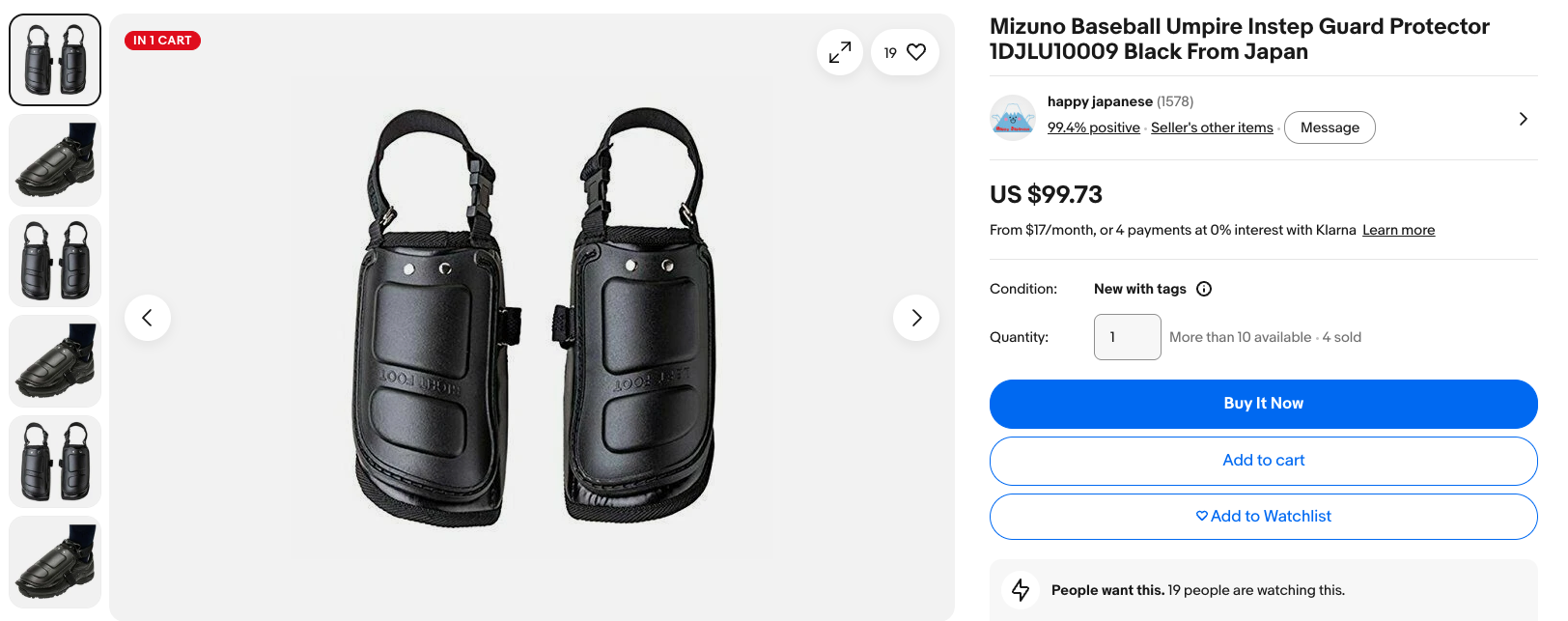
Mizuno Japan beat you to it, TMiB.
-
Maybe I'm missing something. I am saying from 60 feet and 6 inches away, with him standing on a hill, if he looks like he is touching, he is touching as far as I am concerned. I'm making that call. I'm willing to get with my partner afterwards, but I'm not parsing whether he was touching it on a sub-atomic level.
-
This has been my exact thought process. The goal shouldn't be to design a shoe, but to design the protection for the shoe.
-
Why do I care about advantage? Does it say he can do this as long as it is not an advantage? (Not personal, but I loathe this line of thinking in umpires.) But sure, I will play along with your line of logic of "advantage." Coach in the press box is calling/sending information down to him. Now you have prohibited electronic communication. If he/she is using it for anything other than scorekeeping, it is a prohibited device. That is what comes to my mind. My bigger concern is safety. Yes, I have prevented/chastised coaches in the coach's boxes from taking calls and texting. (Not run them from the game, but instructed them to stop or come back when they are done.) I have made coaches take off their legal communication ear piece (legal in the dugout on defense, not legal on offense in the coach's box).
-
I recently took part in one of the largest democratic annual meetings in the country. In our caucus, there was serious misunderstanding of "not adopting a position" (we are choosing to remain neutral) and "not having reached a position" (we were unable to reach a majority or did not even discuss the matter). The chair used "the body has no position" in all contexts.
-
Unless the intent is to stay in the way, then you are intentionally interfering. I am curious which part you object to. It specifically says the runner does not have to leave the base, but does have to give the fielder opportunity to make the play. That means staying in the way could be interference. I will agree simply "not moving" might not be interference, but it most definitely might be. There is additional context that is needed. It is like "continuing to run." The incident itself may or may not be interference, but only the obtuse readings conclude it can never be interference.

-
If you choose not to decide, you still have made a choice
-
Let's look at it this way: What possible advantage can a coach gain by scrolling, texting and answering a call? Nothing comes to my mind. How about yours?
-
Easy. Plate shoes. This is the one piece of equipment that should, and needs, to completely alter its convention. They are a – pardon the obvious pun – walking contradiction. As a company, you can only put so many resources into these shoes, make 'em like tanks (which they do), only for them to invariably wear out in some way. Whether that be internally, the sole / traction diminishes, or they get stepped on and damaged. Then you have the wildly broad range of size combinations – from as small as 5 (I'll never forget ya @Tksjewelry !) all the way to 16-17, and then from D to 4E in width! ... and then there's preferences on low, mid, or hi-top!! ... and then there are those cantankerous, stodgy users who want demand all-black! (How in the heck are you supposed to promote athleticism and advertise your company on an all-black shoe??!!) It is a daunting design challenge. Certainly, with the latitude of "money no object or barrier", something may one day emerge as a solution. If I was to undertake this one, I'd separate the protective components from the shoe itself. Let shoe manufacturers (continue to) make shoes in the variety of sizes, widths, and styles – and white embellishments!! – like they're fully capable of doing, and then develop a toe cap and tarsal plate that is durable, protective, (relatively) easy to install, and secure enough to be used by a variety of umpires, at a variety of levels, for both baseball and softball. Surely, with all of the resources we now have available to us, we can come up with something more refined and adaptable than heavy leather shoe-boots, in a restrictive array of sizes, at an exorbitant price point.
-

At Face Value (Magnesium Masks & Other Things)
Marcus6 replied to MadMax's topic in Umpire Equipment
And Ramos got absolutely drilled directly in the middle of his mask by a foul ball in today’s Cleveland/Minnesota game - seemed perfectly fine and continued. -
You would know if you were aware of how he engaged in the set and the windup, ie: his mannerisms.
-
Rich can speak for himself obviously but I find the Incrediware comfortable to wear for prolonged periods of time. They are fabric and not neoprene so breath and they aren't overly tight. Just comfortable to wear all day. They won't limit motion or provide as much support as neoprene sleeves (of which there are varying levels of braces and weight). I think they are good for lingering knee issues in a non-high activity level setting.
-
Not moving is not intentional INT unless you are dealing with NFHS umpires who take to heart Caseplay H.4.2 - H which I don't.
-
Curious to know more about what it is you like about these? My wife fell at the beginning of the summer (on vacation) and cracked the top of her tibia. She is scheduled to have the range limiter removed in a few weeks, but they recommended continuing to wear the brace. She was asking about when she goes back to work (she is an OR nurse and is on her feet and moving a lot), and they said she could still wear it for support and stability. It is kind of bulky though. Wondering if this may be an option.