TheLovejoy
-
Posts
159 -
Joined
-
Last visited
-
Days Won
1
TheLovejoy's Achievements
79
Reputation
-
It's actually really funny you mention this. We had a discussion just this year about the differences in coaches/levels of play, and who we need to hold accountable to know the rule. Then, help accordingly. In not so certain terms it was something like, 'The programs that pay their coaches full time, enforce the CI and move on. Let them bring it up. Your 16u, or 14u junior league games, enforce it, and help educate the coach on the options.' At the level where the coaches are basically still volunteer dad coaches, help them. But once the coaches are paid by the programs to just coach, they need to know what's going on. What we get are some High School soph/frosh teams who are just surviving because some mom volunteered to help coach so they could have a team. Then, some American Legion program where the head coach makes 60k a year. They are not expected to know the game the same way.
-
I do personally think most of these could be left up to state associations to adopt or not depending on what works where they are. For example, South Dakota, Wyoming, and Montana don't have sanctioned High School Baseball. South Dakota has had High School Club baseball, but it's not sanctioned and is just a preseason to the American Legion season. American Legion is the much more popular baseball. It uses mostly OBR, with a few things that they haven't adopted, (expanded runners lane, bigger bases, coaches mound visits). They do already have delayed dead ball balks. So when the High School season starts, we have many more people that get confused as to what happens when a balk occurs and a pitch is thrown or it's on a pickoff than not. (Yes, it's simple to all of us/you that have worked a ton of games. But, the boomer whose been doing American Legion for 20 years, watches the MLB on tv 7 nights a week, and now has some High School games, it's harder to grasp.) I just think that so long as states aren't playing high school games against each other, most of these liberal rules can be left up to state associations.
-
Unrelated: American Legion FTL!! We're right in the middle of American Legion country here. High school baseball isn't nearly as popular. While the rest of the country finishes their high school season and moves on to the more casual, "mess around/not serious/travel" summer ball, we're just getting into the heat of things where American Legion is the only baseball that really matters. It's a dying breed. Related: We aggressively train our umpires to go out on nearly any fly ball where the center fielder moves in, back, or toward right field, or when the right fielder moves at all. We do this for several reasons: 1. With nobody on base, what does it hurt? (As long as your plate umpire can move a little.) 2. We train for three-man mechanics, where we always go out with nobody on. Since we work three-man crews for all in-state sanctioned games and all postseason games, it's good to build that habit. 3. We have a couple of white billboards beyond the fence, a flashy scoreboard, and other background distractions that can make the ball difficult to pick up from a distance. I'm definitely not blaming your homie, but on a deep ball to right-center, I'd absolutely go out on it. He's going to be 150+ feet closer to that ball than you are. As Scuba said, from the field, when we have a ball that could potentially leave the park, we try to get a feel for where the ball is so we can glance at the touch, then get as many eyes on the ball as possible. Then, when the offensive coach comes out, we can get together and be confident in what we collectively saw. Likewise, when the defensive team says, "He didn't touch first base," our response is: "I did not have him missing first base." Not, "He touched first," or, "He didn't miss first." We intentionally say, "I did not have him missing first base," (or "I did not have him leaving the base early," etc.). You're not saying it didn't happen. You're simply saying you did not have it that way.
-
The trick with this is that he can lift his leg, and the leg can be coming straight down, or even at a slightly downward angle toward home (probably very little or he'd fall toward home, but nonetheless toward home), and then at the bottom swing it back behind the rubber and then you'd have him stepping toward the base, and it would be ok.
-
So these are tough angles to call, but I'm going to give my thoughts just because me and some of my seniors discussed this a couple weeks ago: Also, you're more experienced than I, so I'm not saying anything you don't know. Just trying to give my thoughts on what I look for directly. In any ruleset, if the leg begins lowering any direction besides toward 2nd base, it's a balk. So, even if it's going 'straight down' after he lifts his leg, it's a balk. That would be him 'gaining ground' toward somewhere other than 2nd base. So in your sentence, I'd agree. I just worded it differently. If it lowers before gaining ground toward 2nd, he's actually gaining ground toward somewhere other than 2nd. To me it looks like the kid in the black is probably ok, and I wouldn't balk it. The kid in the red, it looks like he's coming down first, then swings it back. I'd balk that.
-
I don't know why I'm commenting, because your point is spot on and as somebody who does multiple leagues I couldn't agree more. Just for clarification I guess- that American Legion does follow OBR, but they do indeed have a fake tag clause. It's one of the additional rules. American Legion specifically is a F'in dinosaur.... They used to play 9 innings, no run rule, no re-entry, courtesy runners, a bunch of old boomers that had a hard on for being as much like the MLB as possible..... The game has changed homies....nobody wants to be there for 4 hours any longer. Adapt or die....and American Legion is working on dying.
-
^^^ This. Study the 'wedge' on tag plays. There are 2 wedges on every tag play. Let's see what is known, everywhere, and relate it to that: First, think of yourself getting to 3rd base line extended on a ball coming from the outfield to the plate. You're off the catchers hip, tracking with him, catching the 'back half' of the wedge. The OTHER wedge on this play, is nearly exactly opposite of where you are tracking this play from. It would be up the 3rd base line just a bit. Now, obviously we don't want to be there with a ball coming in from the outfield, but that's the other side of the wedge. It's the 2nd most ideal position. Inside the 'cutout' inside the line just a bit, so you don't get straightlined by the runner. Now flip everything about that play at home plate, and put it at 2nd base. The first, most idea position for U2, is in a 4 man crew, OUTSIDE of the infield, tracking the steal of a runner at 2nd base by essentially being at 2nd baseline extended (I just made that up), the line from 1st to 2nd extended, working off the fielders hip (the one taking the throw from the catcher on a steal). However, in a 2 man, you don't get the luxury of being there. So you take the inside of that B position, to catch the other half of that wedge. If you're in the Deep C, (relate this to a play at the plate), you'd be somewhere like, 6-10 feet up the first base line. Well, that doesn't make any f'ing sense..... So, why on earth would we want to be in Deep C on a steal at 2nd? Flip everything you know about plate positions on plays at the plate, mirror it, apply it to 2nd base, and you'll see it.
-
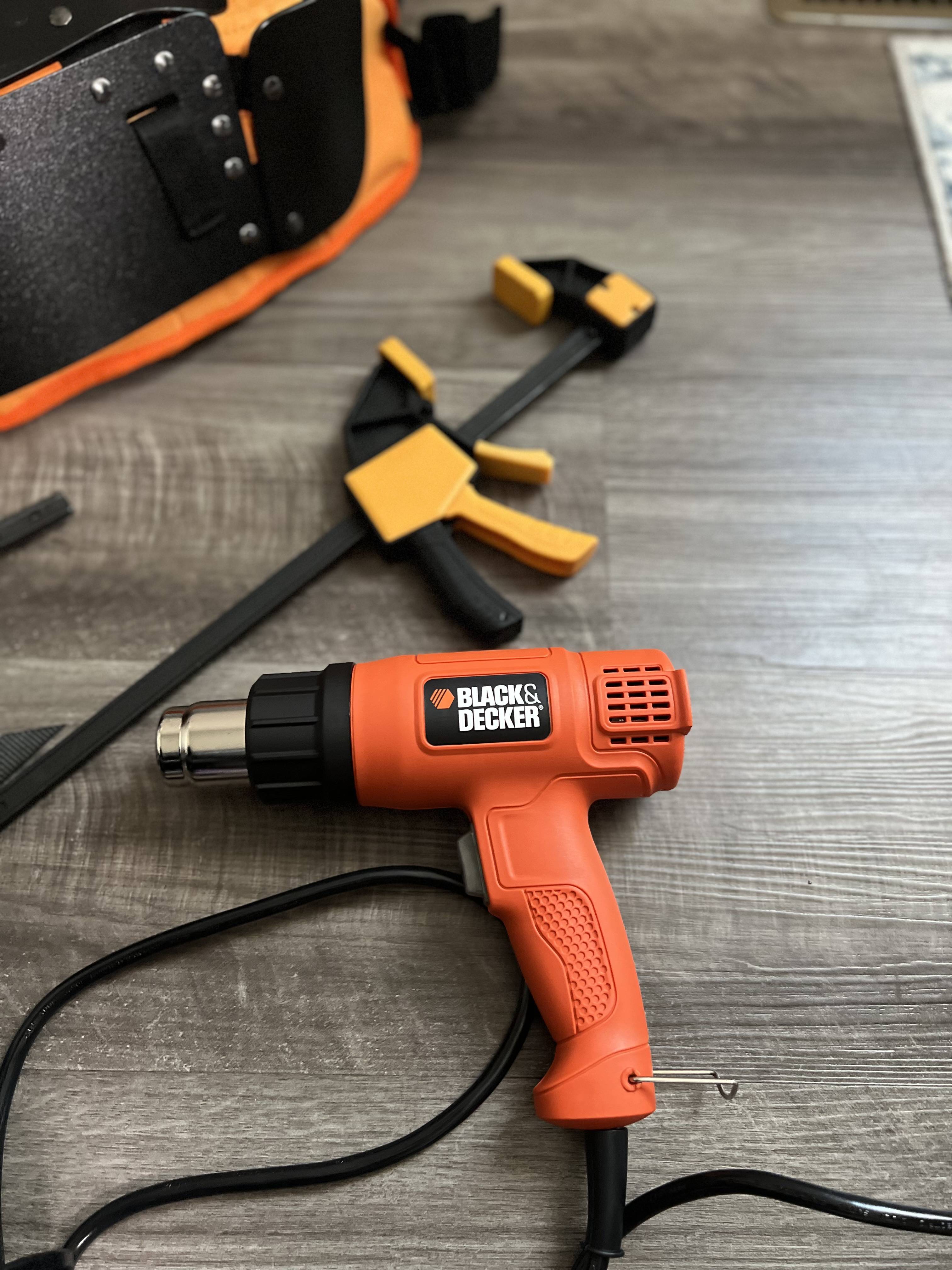
Max, and others, will be give you infinitely more valuable information and steps, but I'll let you know what I did. I grabbed a heat gun, 4 woodworking clamps, 4 lashing straps, a bucket of iced water, and a cup. These pics are just examples of how I had it set up once heated. Remove all of the padding for anything that you're going to heat. I started by heating up all of the shoulder pauldrons, on both sides, top, bottom, inside, out, and edges. Somebody mentioned earlier that it's easier to under-heat it, and have to do it again than to over-heat it and have melted plastic. Just slow circular motion all over all of the shoulder pieces. Then I took the clamps and straps and basically bent the plastic to the shape I wanted it, on all of the shoulder pieces, then set the chest protector up in the driveway, laying chest up. The first time I did this, the shoulders didn't hold form very well. The 2nd time I did this, I used the iced water and cup to pour iced water all over the shoulders, inside and out. The 2nd time it's held the shape very well. The limited edition CP seems to be much more 'stiff' padding, so the padding worked the shoulders a little more flat. Like, it presses back on the shaping once you re-install the padding. The OG CP is much more flexible and the shoulders haven't moved at all.


-
Here's my conundrum tho..... As an avid suit wearer, and semi-fashion police....I can't wear white shoes, unless I wear a white belt, (white accessories to accent the colors). And a white belt is no good. So, I can't just rock the white shoes in good conscience.
-
Here's my conundrum tho..... As an avid suit wearer, and semi-fashion police....I can't wear white shoes, unless I wear a white belt, (white accessories to accent the colors). And a white belt is no good. So, I can't just rock the white shoes in good conscience.
-
You're just asking, right?-with no hidden negative connotations? Because.....if somebody gives me the ok to rock the White SSK Plate Shoes.... I will be the first in the USofA to show up with them.... I wish I was joking.
-
I want to hear how this goes, the process, the results. I'm the most intrigued on this. The Rawlings padding has been thin enough, and it's 'clean/smooth' enough that any padding that I've stuck to the inside of it for sizing, has stuck and stayed without any problems at all.
-
Yes. Absolutely does. I think I'll keep my sizing foam in the back, and the D30 in the front where the impact comes from.
-
I wasn't thinking of doubling it up to supplement it. I was thinking more of put it in the front, so it does it's job the way it's supposed to as it. As a secondary function, it would help size the fit just a bit, instead of me needing that 1/8th inch sweat liner. I was more looking at it from a, "is this going to hurt the D30 role it's designed for by place it over the already existing 'thin' Rawlings pad?" There was a very specific mouthguard back in the day, Protec Dent, or something like that, that required the hard teeth background to perform it's action. It had perforated holes in the guard to disperse impact across your jaw. The mouthguard was extremely hard compared to other football mouthguards, the big soft rubber ones, but when a ball would impact it, it spread the impact across a wider area and would keep your teeth in tact. But if the backing surface of it was too soft, it wouldn't perform correctly, and was MORE dangerous than wearing nearly nothing as a guard at all. Now, understanding that you didn't invent D30, and you don't want to make any official claims...you also know infinitely more about it than most of us, and that opinion is valued.
-
You see where I put that bike sweat liner in the front?- That bike D30 that was linked, has it's own sticky stuff attached that just peels, and boom, it sticks. After seeing this, I've thought about just using that D30 to the front of the mask instead of the little pad strip that I use. Now, I understand, like you said, it would be a disservice to double it up with the default Rawlings pad. But, this seems like a super easy 'fix/addition' to the pleather Rawlings pad in the front. Add the D30 to it to give it better up front protection, and a little bit of sizing detail. Eh? (I'm just trying to clarify that I don't want you to send me to padding purgatory for doubling it up)