Jay R.
-
Posts
122 -
Joined
-
Last visited
Everything posted by Jay R.
-
You have to touch the base your last time by it. Full explanation here:
-
1. The coach probably shouldn't discuss that call with the umpire, at least not for long. That's a $50 call---pay another $50 for a second umpire, and then they shouldn't both miss it. I was coaching a 10U team in a tournament and a player touched first base as he ran through, circled back in foul territory toward the base, then ran to second, passing between home and first without touching the base again as my team tried to get another runner out. I appealed the missed base at first, got a safe call, and asked for time. I asked the umpire what he saw; he said he saw him touch the base the first time, focused on following action at the other base, and didn't see anything after that. I said that the runner circled completely around the base and missed it the next time, but I understood why the umpire didn't see it, thanked him, and walked away. 2. They should ignore it. It's incumbent on teams to know the rules governing, for example, U3K and infield fly. Those probably shouldn't be in effect at 10U, but if you're teaching them, teach them to know the rules and play accordingly. 3. A signaled time is time out. That said, managing time out and time in play is something most amateur umpires are, frankly, not very good at. I wish I could give you more concrete advice. Given what's happening in the league, you may be better served asking a league official. Failing that, you may want to join the board and force them to clarify what their rules are, including base rule set for anything not covered by local rules.
-
Also, sincere kudos to the announcer for simply saying that he doesn't know the rule about when the fielder is out of play, rather than making something up.
-
Batter unintentionally slings bat which hits catcher
Jay R. replied to johnstfm's question in Ask the Umpire
This is what the LL chapter that I worked for was looking for as a best-case scenario: The manager removes him from the lineup, we interpret it (at least in the regular season) as an injury that prevents batting (and is thus not an out), but the player is still eligible to play the field and avoids the suspension that comes with an ejection. -
I guess Alexandria pays better, but Arlington's cancellation policy is better
-
Batter unintentionally slings bat which hits catcher
Jay R. replied to johnstfm's question in Ask the Umpire
This is the issue. Some younger kids have the habit of throwing the bat, and 10- and 12-year-olds are strong enough to cause injury with them. When you watch the same batter throw the bat past your head in his first at-bat and hard into the catcher's shins the second at-bat, he can't get a third at-bat that game. -
Batter unintentionally slings bat which hits catcher
Jay R. replied to johnstfm's question in Ask the Umpire
Absent a local rule that specifies that the batter is out, in youth leagues I would probably treat it like Little League---delayed dead ball, warning on the first offense, removal by the coach or ejection (coach can pick) for safety reasons on the second. I agree with @beerguy55: You can't give each player a warning. One per team is plenty, especially if they're as dramatic as you describe here. If you notice that bats are ending up in weird spots but don't want to officially warn or eject, you can quietly point out additional occurrences to the coach if you want, to build your case for the eventual ejection. At least in Little League (not sure about Ripken) an ejection comes with an automatic one-game suspension. When reminded of this, most coaches will choose to remove the player. The play in the OP would stand, assuming that you judge that the thrown bat did not interfere with the defense's ability to play on the ball or runners. -
Agree with @Grayhawk on that being a typical setup. I will say that a Little League I worked in had a standard that the half-game fee was in place until the plate meeting.
-
Officially starting my little league umpire journey tomorrow
Jay R. replied to orangebird's topic in Youth Recreation Ball
I am somewhat impressed that they included D. I've only ever seen one other local rules for stealing address balls out of play, and even that was indirect (something to the effect of "A base runner may only score on a play that begins with a batted ball or as a result of being forced home on a walk" as a concluding point to the baserunning rules mods, which included stealing). -
Did this actually happen, or is this hypothetical? If it happened I would love to see video.
-
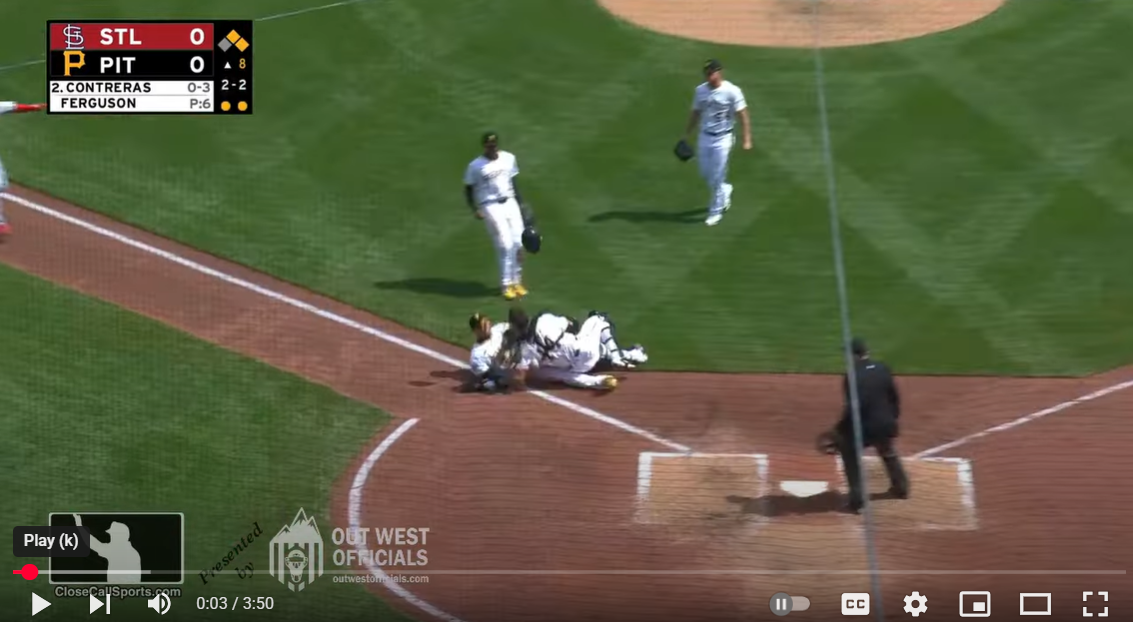
1) The runner is coming in clearly in foul territory. In this screen grab the ball is somewhere between the fielders on the ground. I guess here I can see your point that the fielders are effectively blocking the same area, one has the ball, so... fine. Agree to disagree, but I see your point. 2) By here the runner has already been forced to deviate by what he might think is a fielder with a ball. That said, by around here he has to realize that it's loose and he's now trying to score. At this point no one has the ball, and there are three fielders between him and the plate. 3) In this screen grab F5 still doesn't have the ball but a portion of him (his right arm and maybe his right leg) are in the runner's new path to the plate. Granted that this is extremely tough to call in real time, especially as PU watching for catch/no and fair/foul, but I don't think they got it right.


-
Pirates fan here, and I agree with @Richvee. As soon as I saw it, I thought, "Whichever fielder is unprotected is obstructing the runner's way to the plate." To say nothing of the runner having to run around two fielders without the ball after it landed.
-
Interference with a Batted Ball- Little League
Jay R. replied to Ssagner42's question in Ask the Umpire
Tangential: Remember that in LL (as in MLB, but not as in high school) for the purposes of interference the ball has to be hit "through or by" the infielder, not merely past them. -
Officially starting my little league umpire journey tomorrow
Jay R. replied to orangebird's topic in Youth Recreation Ball
Similarly, I have told 10U rec coaches (if they ask nicely) that I call the zone for that level in something like a diamond. If it's chin high or mid-shin but down the middle of the plate, it's a strike. If it's between the batter's boxes at the belt, it's a strike. Most react pretty positively to that. -
PONY does not. Rule 8-F requires that catchers wear "a mask with throat protection," notes that "hockey style masks are permitted," and says explicitly that "Mask extensions are not needed."
-
It is that. I will also say that, when I was working LL, it was one of the few things that I deviated from (always pregaming with my partner of course).
-
Perhaps also of use, depending on what was used at your trainings: Little League's Rules Instruction Manual. This is the 2023 edition; @Velho or @stevis might be able to let us know if there are any significant changes to their interpretations since then. http://www.orwua.com/2023-Rules-Instruction-Manual-rev20230221.pdf
-
Seems to be produced by LL District 8 in CA, rather than the home office, but echoes what's been said here. Page 90 has what you're looking for. https://cdn.prod.website-files.com/63ddc50d014ddc83905ba29e/6428a7a762519371804a5d4b_60 FT - 2 Umpire Mechanics (4-1-2023).pdf
-
That one really threw me when I took the test last week.
-
Don't know what their current practices are but Alexandria LL in Northern VA paid quite well 2013-19. My base rate was $60 (or maybe $65?) in 2019. I got a $10 bonus for 70- or 90-foot diamond games (the chapter had through LL Seniors, I think), and anything solo was 1.5x. So a solo LL Majors game was at least $90, and a solo LL Intermediate $105. (We weren't scheduled to do 90' games solo but it happened once or twice, especially in the fall.)
-
I did a lot of Little League (which has explanatory material and not a lot of local rule options) in northern Virginia, but have switched to PONY baseball and USA Softball in leagues since moving back to southwestern PA. Both baseball and softball locally are heavy on rules mods, and there's inevitably something about a requirement to slide (in addition to USA Softball's "crash" rule). After conversations with several board members and umpire coordinators in various leagues, I de facto call it with the Little League guidance in mind. It is helpful to remember that the catcher can't block the runner's access by awaiting the throw on the plate. If the runner runs into them while they're standing on the plate, the answer is probably "obstruction" or "nothing."
-
@JSam21 That's fair, and that's the needle I'm trying to thread here given the age levels (and the overall temperature of this league; I've worked other youth leagues that emphasized the different roles of umpires and coaches). When discussing the high school hypothetical you said "the radar goes up for sure." What would it take to get you to say something? Three consecutive pitches? Four? Would you do any coaching or go straight to the ejection? Absent any malicious intent, do you let it go indefinitely?
-
Absolutely. If there is an obvious mechanical issue (not looking, not standing up, throwing sidearm when there's a batter on your arm side, etc) should we not try to correct that mechanical issue to try to prevent things from escalating, especially in youth rec ball? Several youth leagues I've worked have rules on this, though this particular league does not. I think the local fastpitch softball league says two in an inning or three in a game. I think that if there were an analogous situation---a 9-y-o pitcher who's been dealing for two innings hits batters on consecutive pitches---I would make a mental note after two, after three ask the manager to go to the mound to have a conversation, and after four ask the manager to remove. But I see way more hit batsmen overall than I do batters hit with return throws; I don't think a hit batsman or even back-to-back hit batsmen is as easily correctable as asking the catcher to avoid hitting the batter on the return.
-
Would you ignore it if say, in a high school game with the bases empty a catcher hit a batter with consecutive returns? Asking honestly, not trying to stir the pot. Tend to agree, though my concern for player safety had me wondering where I would draw the line.
-
No, but neither did the batter react much.