Jay R.
-
Posts
126 -
Joined
-
Last visited
Everything posted by Jay R.
-
@JSam21 That's fair, and that's the needle I'm trying to thread here given the age levels (and the overall temperature of this league; I've worked other youth leagues that emphasized the different roles of umpires and coaches). When discussing the high school hypothetical you said "the radar goes up for sure." What would it take to get you to say something? Three consecutive pitches? Four? Would you do any coaching or go straight to the ejection? Absent any malicious intent, do you let it go indefinitely?
-
Absolutely. If there is an obvious mechanical issue (not looking, not standing up, throwing sidearm when there's a batter on your arm side, etc) should we not try to correct that mechanical issue to try to prevent things from escalating, especially in youth rec ball? Several youth leagues I've worked have rules on this, though this particular league does not. I think the local fastpitch softball league says two in an inning or three in a game. I think that if there were an analogous situation---a 9-y-o pitcher who's been dealing for two innings hits batters on consecutive pitches---I would make a mental note after two, after three ask the manager to go to the mound to have a conversation, and after four ask the manager to remove. But I see way more hit batsmen overall than I do batters hit with return throws; I don't think a hit batsman or even back-to-back hit batsmen is as easily correctable as asking the catcher to avoid hitting the batter on the return.
-
Would you ignore it if say, in a high school game with the bases empty a catcher hit a batter with consecutive returns? Asking honestly, not trying to stir the pot. Tend to agree, though my concern for player safety had me wondering where I would draw the line.
-
No, but neither did the batter react much.
-
I admit I was thinking about that even before the coach came out---if the third pitch had been a borderline ball that the catcher caught and threw back without moving and it happened again, would I have tossed him? I think the standard for ejecting kids has to be fairly high and without obvious malice I'm not sure that I would have, though it is of a piece, for example, with the LL standard for ejecting someone who cannot hold onto a bat safely. I might have told the coach that he can either sub the catcher or both he and the kid are done (akin to LL's option for having a coach remove the kid before the ejection becomes necessary). In any case the catcher pitched innings 3-4 and then played short.
-
I've been umpiring on and off for a dozen years and had a new situation come up today in a U10 fall rec game (PONY Mustang with local mods, but I don't think it matters other than runners cannot advance home except on a batted ball or forced home on a walk). By the bottom of the second inning, the visitors' catcher has demonstrated that he's both skilled and alternately bored and frustrated. With no one on or runners frozen, he's catching from one knee and throwing the ball back without standing up. With two outs and runners on second and third, a left-handed batter comes up, the first two pitches are strikes, and both return throws are lazy sidearms and hit the batter while he was standing in the box. Clearly not malicious, but both balls hit the batter in the helmet after glancing off either the bat and or shoulder. (No one attempted to advance, given the local rules on stealing home.) After the second one, I called time and asked the catcher to "Please stand up and throw the ball back to the pitcher without hitting the batter." The next pitch was strike three, catcher rolled it back to the mound and walked away. The visiting manager then came out to tell me that the batter needed to get out of the way and that his catcher could throw wherever he wanted. I was flabbergasted---the batter was well within the box, in a legal batting stance, and none of his movements in any way interfered with an attempt to retire a runner. I was polite but the idea was so foreign to me. I explained that there was no reason for the catcher to even come close to hitting the batter and that, especially at that age level, I'm going to protect the batter from lazy play that borders on dangerous. He mumbled a bunch of stuff that didn't make sense, then walked away. I still can't understand what he might have been getting at. Am I missing anything? Should I have done anything differently? (To be honest I was tempted to eject the coach for arguing that the batter should have to dodge returns from the catcher, but I don't think that I should've.) Has anyone seen something like this before, and how did/would you handle it?
-
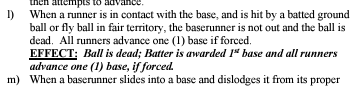
It depends on the ruleset and possibly the positioning of infielders. Under USA Softball rules, if the closest infielder was behind the base, the ball is dead, the batter is awarded first, and forced runners advance one base; if the closest infielder was in front of the base, the contact means nothing, play on. Rules Supplement 44: Under National Softball Association rules, the ball is always dead, the batter is awarded first, and forced runners advance one base. Rule 8-8, "Baserunner Not Out," part L: I have played in a men's league that specifically used MLB rules as the base rule set, with heavy modifications for slow-pitch softball. In that case, the base affords no protection and the runner would be out unless the ball went "through or by an infielder." Rule 6.01(a), "It is interference by a batter or runner when," part 11:


-
After a walk, when can time be called? MLB level.
Jay R. replied to Amgolfer's question in Ask the Umpire
Not immediately, as Kelsey Jansen learned the hard way: https://www.mlb.com/cut4/kenley-jansen-tosses-live-ball-into-dugout-against-braves-c182237644 -
If I'm being paid by one local rec association and their team is playing a team from another association, I try not to wear the home team's colors. Some of the parents in the smaller leagues where I am assume the umpires are in the pocket of the hosting organization. For the tiny association I schedule umpires for, they only use teams in the Texas Rangers' color schemes (royal, red, and powder) plus navy. So it was easy to make black the official color for our umpires. For my son's rec association, I was solo umpiring a preliminary game in a travel tournament hosted by their all-stars (my son was not on the team). I wanted to wear white for heat reasons and had no idea who was playing and what colors there would be. Turned out to not be an issue but if the hosting team was wearing white with navy trim (like my shirt) I would have gone with powder blue. It is absurd, but it happens in small-town rec ball.
-
Yes, OBR had a pitch time limit that was unenforced until the pitch clock. Really good article on that here: https://www.theringer.com/mlb/2023/3/29/23661015/the-forgotten-history-of-the-pitch-clock-in-baseball From the article:
-
Yeah, IFF in youth ball almost always leads to some argument. I was working our local rec Bronco (U12) championship as U1 and the best player in the league came up with the bases loaded and no one out. He absolutely skied a popup between home and first base. The plate umpire and I both took a beat to read the play, saw the pitcher move under it, and simultaneously signaled and called "Infield fly!" (I added "if fair," but I digress.) The pitcher took his eye off the ball as it came down well into fair territory and it clanged off his glove. I emphatically signaled and verbalized "Batter's out! Infield fly!" has he approached first base, given the age group. First base coach is screaming at his runners to run, and R3 is tagged out by the pitcher halfway to the plate. There was nothing ejection worthy but the offensive team tried everything---"No one signaled!" "I didn't hear anyone!" "No one said the batter was out!"---despite the fact that I know I signaled and verbalized and saw and heard the plate umpire do the same. Offensive team won handily anyway.
-
At least in some jurisdictions PU in softball has all fair-foul calls. I was pregaming a Bronco (50/70) baseball game with a guy who's certified by PIAA (PA high school) for softball and does some baseball. Was asking about mechanics and he said that all his softball games are two-man but PU has all fair-foul regardless of positioning.
-
Agree, @Velho. Having worked in both LL and PONY jurisdictions, in my experience local LL leagues adhere much more closely to the rulebook, which means that it's actually been thought through rather than jotted down by a random (well-meaning) board member. I de facto call collisions in youth games in line with the LL rulebook in mind.
-
You can appeal for a "fourth out." From MLB's Official Baseball Rules 5.09(c)(4): "Appeal plays may require an umpire to recognize an apparent 'fourth out. If the third out is made during a play in which an appeal play is sustained on another runner, the appeal play decision takes precedence in determining the out. If there is more than one appeal during a play that ends a half-inning, the defense may elect to take the out that gives it the advantage. For the purpose of this rule, the defensive team has 'left the field' when the pitcher and all infielders have left fair territory on their way to the bench or Clubhouse." Same ruling all codes, except that there may be variations on when the defense is considered to have left the field. CloseCallSports had a great article and video on this.
-
FWIW, I don't believe your rule cited as "both players must avoid collision" is an official PONY rule; I just did a ctrl-F through the PONY rulebook for "collision" and saw nothing; "contact" did not return anything related to contact between runner and fielder. In my experience in a PONY-heavy area most local leagues have a vaguely worded local rule about avoiding contact or collisions that gives broad leeway to the umpire. Even at that the penalty tends to be an out if the offender is the runner or obstruction if it's the fielder. Umpires might call malicious contact or unsportsmanlike conduct and eject the offender if it's particularly egregious but it doesn't sound like your play was that.
-
PONY Bronco (12U), so modified OBR R2 is advancing on a low ball; F2 blocks it cleanly and is on his feet quickly. After the swing, the batter steps toward third base (but still in the box). F2 barehands the ball and pumps at third, realizes he's gonna drill the batter, and shuffles left. Batter has no idea what's going on and steps out of the box, right into F2's path and F2 lowers his arm. I called interference and (incorrectly) called the runner out and resume the at-bat. Aside from the fact that I penalized the runner, I am hearing from a couple people (including my assignor) that a) I shouldn't have called the interference because the batter was in the box on the initial attempt. b) I shouldn't have called the interference because the catcher never made an actual throw. I don't believe that to be the case and can find some blogs that support that but am having trouble finding rule or formal interpretation guidance. Anyone? Given the age level also curious about NFHS and LL if anyone wants to chime in.
-
As described, this is not a force play. If the batter-runner legally touched first and is deemed to have made a move toward second, it's no different then if he had rounded the base and been tagged between first and second. Since it's not a force, the run should count, assuming that the umpire agrees that the runner crossed home before the tag occurred. If he had missed first base as he ran by, he is subject to being out on appeal for missing the base. You could appeal this even after the tag and, if sustained, the run would not count because the batter-runner would have been out before legally acquiring first base. (This is not technically a force play, fwiw; you can peruse the archives for past discussions on that point.) Your rule citation is for a runner who retreats across bases, not simply retreating toward their legally acquired base. For example: A runner on first runs on the pitch, a fly ball is hit, and the runner rounds second before realizing he will likely need to tag up. If he runs in reverse order past second base toward first, and then the ball drops, the force play at second is still on even though the runner has touched second on the play.
-
This. As a coach of (admittedly low-level) youth teams in several sports, I mostly want to know whether the officials are paying enough attention to make a call. I can understand not verbalizing things that are nothing, especially at lower age levels, but signaling seems to be a no-brainer for the benefit of coaches and spectators.
-
Lock this thread already. Use chicken wire if you have to.
-
Starting to Come Set and Stepping Off or Throwing to a Base
Jay R. replied to Jay R.'s question in Ask the Umpire
Thanks @Jimurray That rule is what I had in mind---the youth pitchers yesterday were not going directly from stretch to set "without interruption". So by interpretation this a balk at MLB (and MiLB I presume) but not at youth levels? -
Starting to Come Set and Stepping Off or Throwing to a Base
Jay R. posted a question in Ask the Umpire
PONY Bronco (U12), so modified OBR Been a while since I umpired games with balks---formerly did LL through Seniors, but haven't done that since 2019. Have done closed-bases baseball and softball since then. In a game that I was umpiring last night, pitchers from both teams routinely toed the rubber and stretched, then started to come set and, without actually coming set, threw to a base, feinted toward second, or stepped off. Is this allowed? No one from either bench reacted at any point, but I thought a pitcher had to either step off or throw from the stretch (before starting to come set), or come all the way set and then throw. Thanks in advance. -
Little League would not be a violation if the runner is running directly toward second base at time of throw.
-
Babe Ruth/Cal Ripken, outfielder plays close backup and tags runner.
Jay R. replied to NGuzman's question in Ask the Umpire
I'm not familiar with Babe Ruth or Cal Ripken, but my kids' league at 8U (coach-pitch) had a rule that outfielders were not allowed to make plays in the infield. Your exact scenario could not have happened in my kids' league, because they were not allowed to run on overthrows from the infield. (If the ball was hit past the dirt, the batter and any runners could run until the ball was controlled in the infield by an infielder. If the ball was hit within the infield, they could only advance one base, regardless of overthrows in any direction.) The rules did not specify a penalty for outfielders making a play in the infield, and we did not use umpires except for one umpire for the championship game at the year-end tournament, but in practice it was treated as Type 1/A obstruction. The most common scenario was, with a force play at second, the center fielder would take a sharply hit ball and run it to second. Time, the runner is safe, all runners can advance one base from where they started (assuming they were running or forced). So if your league has a local rule, I'm inclined to agree with the incoherent coach---but also, if I'm umpiring that game and they don't give me the written local rules ahead of time, I'm letting the play stand and not relying on a coach's interpretation of them. -
Trail runner passes lead runner, lead runner never advances on force.
Jay R. replied to NGuzman's question in Ask the Umpire
I'm guessing that the OP doesn't (or at least didn't immediately) get the difference between protest and arguing. -
Players needed to start a game, players needed to continue a game...
Jay R. replied to SeeingEyeDog's topic in Rules
Chiming in on the side conversation about whether to work a game if it's not official. I don't think it's black and white. The league my kids are involved in is laid back and less structured. Being somewhat rural it's not uncommon for games to start with fewer than the required number, and it's understood that it's all developmental anyway. I've umpired games there with as few as six on one side (usually the other team supplies a couple outfielders) and even 8-on-7 isn't uncommon. On the other hand I umpired in a competitive Little League chapter with a tight schedule on Saturdays and strict rules about what was and wasn't a game. If a team got to fewer than 8 players, the game was over. If I had a good relationship with the coach and time allowed, I might call a couple scrimmage innings. But I also had no trouble saying I was leaving when adults started wanting to play with or against their kids---at that point they can call their own game and the likelihood of injury and thus lawsuits went up. Ymmv.