Coach Carl
-
Posts
134 -
Joined
-
Last visited
-
Days Won
1
Everything posted by Coach Carl
-

Coach calling timeout and walking onto the field while ball is still live
Coach Carl replied to Side Retired's question in Ask the Umpire
I'm travelling so I can't get the specific rule and language, but, in FED, the batter stepping out of the box is a penalty strike. Batter steps out (penalty strike), ball stays live, pitch is a strike. You have two strikes added to the count. -
https://mktg.mlbstatic.com/mlb/official-information/2025-official-baseball-rules.pdf The answer is in Rule 5.11 1. No, the player cannot come back in to pitch (see first bolded part below) 2. I think the rule I quote below assumes a situation in which the player goes from the mound directly to defense so I am not sure if he can come an play defense later in the game. Since 5.11(a) allows, in general, for a switch from DH to defense [see 5.11 (a)(12)], I think he can (but this will terminate the team's use of a DH for the rest of the game). See the second bolded part below, which is also what 5.11 (a)(12) says. 5.11 (b) Starting Pitcher as Designated Hitter. It is not mandatory that a Club designate a hitter for the pitcher. However, in the event the starting pitcher will bat for himself, the player will be considered two separate people for purposes of Rule 5.11(a). In such cases, the manager should list 10 players on his team’s lineup card, and this player should be named twice – once as the starting pitcher and once as the Designated Hitter. Thus, if the starting pitcher is replaced, he can continue as the Designated Hitter (but can no longer pitch in the game), and if the Designated Hitter is replaced, he can continue as the pitcher (but can no longer hit for himself). If the player is simultaneously replaced both as a starting pitcher and Designated Hitter, he cannot be replaced by another two-way player filling both roles as separate people (this can be done only once on the initial lineup card by identifying that the starting pitcher will bat for himself). Notwithstanding anything to the contrary in Rule 5.11(a) above, if that pitcher bats or runs as Designated Hitter, such move will not terminate the Designated Hitter role for that Club; neither will the role be terminated in the event that Designated Hitter assumes the role of pitcher on defense. However, if that player is switched from the mound or Designated Hitter role to a position on defense other than pitcher, such move will terminate the Designated Hitter role for that Club for the remainder of the game.
-
A runner is assumed to have acheived a base when he passes it, even if he does not tag it. The defense must appeal the miss in order to get a ruling from the umpire (if missed, the umpire calls out, if tagged, he calls safe). An umpire should be careful not to tip off either team of the miss, if he sees it. It is the defense's responsibility to see it and appeal. It is the runner's/offense's responsibility to notice and try to correct the error before the appeal is made. I'll let my umpire friends correct me if I am wrong, but with no play at the plate you shouldn't get a safe signal. Since the defense did not try to tag the runner, there is no call to make.
-
I pictured it like the attached, with one exception, the glove is not touching the ground. In this photo the fielder is on his way over the fence and lands in the Boston bullpen but in our OP we have him stopping his momentum and getting back onto the field of play without ever touching the ground in DBT. It is a third world play, which is probably why we won't find definitive answers.
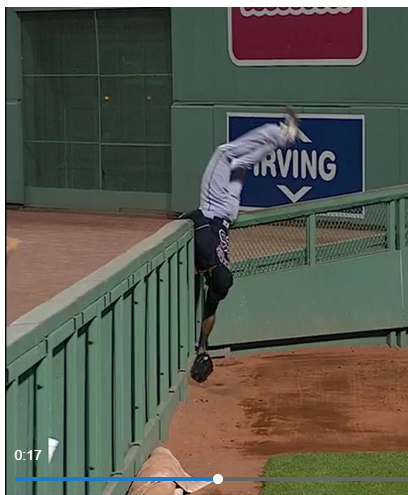
-
The defense in your play is appealing that the runner left early. A valid appeal would be tagging either the runner or the base from which he left early, but they must do it before the runner corrects his infraction. Typically, the defense chooses to tag the base and this creates the race to the bag that looks similar to a force play.
-
I assumed the legal catch was not under contention but that the issue is, at what point has the fielder taken the ball out of play? I've applied the logic of the rule that you and I both quoted to determine when, in general, a fielder is out of play. @johnnyg08 has described that the fielder's body is completely over the out-of-play area (even though it hasn't touched the ground in the out-of-play area). This means both of his feet are over the out-of-play area, which I think is the relavent fact. When at least one of his feet is no longer over the playing surface isn't he now in an out-of-play area? Does he need to touch the ground before he is considered out-of-play?
-
Use the same logic as the rule for when he can no longer make a legal catch. Once he no longer has at least one foot over the field then it's time to kill it and award bases. From OBR: "one or both feet on or over the playing surface and neither foot on the ground inside the dugout or other out-of-play area". Based on your description, he met the second requirement but not the first.
-
He was shopping for a call. When you put up the "Sorry, We're Closed" sign, he gave up. I call that a win!
-
"A" all the way.
-
My work rules prohibit viewing the better video in the Twitter link, so I am only going off of the embedded video in the OP. However, quoting @Velho's post: "Orioles manager Craig Albernaz said umpires told him that Ernie Clement "established a baseline outside of his running path" and that Gunnar Henderson's tag attempt wasn't good enough on this play in the 6th inning." I wonder if the explanation was actually, "wasn't soon enough." In other words, in the umpire's judgment, the runner started running to his right before the tag attempt was made.
-
Under Objectives of the Game (OBR Rule 1): 1.02 The offensive team’s objective is to have its batter become a runner, and its runners advance. 1.03 The defensive team’s objective is to prevent offensive players from becoming runners, and to prevent their advance around the bases. Getting the umpires to help you fulfill one of the objects of the game is a no-no and umpires should not succumb to it. Stop them yourself. Younger ages have rules in place to account for differences from the adult game. One of them is no leading off on 60 foot basepaths (or stealing would be pretty much a non-competitive play). There is no reason for an umpire to call time for the defense to stop runners when the rules proscribe a specific way to do it. This problem takes care of itself as the kids get older. Play on larger diamonds makes it a much riskier play for the offense to test the defense in close quarters.
-
This is the text of the Major League Rule (OBR - Official Rules of Baseball): 5.08 How a Team Scores (a) One run shall be scored each time a runner legally advances to and touches first, second, third and home base before three men are put out to end the inning. EXCEPTION: A run is not scored if the runner advances to home base during a play in which the third out is made (1) by the batter-runner before he touches first base; (2) by any runner being forced out; or (3) by a preceding runner who is declared out because he failed to touch one of the bases. Unless one of the exceptions apply, as long as the run scores before the out is made (not when it is called, but when it is made), the run counts. This is called a "time play" as Mr. Velho says. Your runner who was out at second does not fulfill any of the three exceptions.
-
Legal bats for Babe Ruth 13-15 are USA or BBCOR. On an appeal by the defense the umpire inspects the bat and rules if legal or illegal. With no USA or BBCOR marking this should have been ruled an illegal bat. Even if the umpire thinks it is a legal bat, if the marking is missing, he should rule it illegal. If the defense appeals before the end of the at bat, the penalty is removal of the bat and the at bat continues with a legal bat. If the defense appeals after the end of the at bat, the batter is ruled out (assuming he made it on base safely), all outs made during the at bat stand and remaining runners return to their bases at the time of the pitch that was put into play. And, of course, the bat is removed. Since It appears the umpire ruled incorrectly, the defense has two options: (1) accept and move on or, (2) protest. Ejection is not a penalty. Though, if the batter tried to use the bat again, that would be grounds for ejection.
-
Just to be clear, because some may misconstrue: Once the player enters dead ball territory, he can no longer correct his error. He doesn't have to sit on the bench or even be in the dugout as long as he has entered DBT. As an example, a field in my league has a gate in the fence that is half way between home and the dugout. A turn and walk of about 8-10 feet leads to the actual dugout.
-
I'm envisioning a coach trying to "teach a lesson" by way of embarrasment. That is not in line with Little League's mission and values. But, unless the situation is egregious, I think an umpire's default postition of staying out of the dugout would make any action on the part of the umpire difficult. However, there is some rule support for the umpire to act. 9.01 (d) allows an umpire to "disqualify...for unsportsmanlike conduct..." and the 2018 RIM note under 9.01(d) says, "Keep in mind that unsportsmanlike conduct or language could exist toward an umpire, the opposing team, and even a member of the same team. Do not allow bad behavior to continue, even if it's not directed at you." The "same team" standard is different that the "umpire" and "opposing team" standard, but it does exist. There are so many possibilities to consider when judging whether or not the coach crossed a line. But, if in your judgement it was crossed then warn and eject. In my league we've had coaches who are yellers and they've been told by the umpire to calm down with follow-ups by league administrators. At the very least, send a note through the appropriate channel to make the league aware of the situation.
-
Albert Belle might have liked to challenge a ball four.
-
The out at first is not a force out, so the run counts. A force occurs as a result of the batter becoming a runner. R1 was forced to 2B until the ball was caught. After the catch, he is no longer forced to 2B (or back to 1B). He is, however, liable to be out on appeal for leaving the base before the fly ball was caught. So, the throw back to first is an appeal for leaving early (they could also tag him). Since the rules allow him to correct his error before the appeal, you get the action of the runner trying to beat the throw to the base. That looks similar to a force play, but is not.
-
I see now that I was conflating your general statement of principle as a criticism of how you thought that the umpires ruled in the actual situation.
-
Per the play by play on the Virginia website, the runners were not returned: https://virginiasports.com/boxscore/18676 You have to navigate to play by play. It was in the 6th inning.
-
The umpire pointed at the bench player and made a safe signal so I presume it was a ruled foul. The first fielder (#5) seems to reach into the dugout unimpeded but he misjudged the location by a few feet. The second fielder seems to have never gotten to the point of reaching over the railing at all. It even appears that he was still a step away when the ball hit the bench player's shoulder and then he falls into the railing.
-
As I read the rule I see the logic as such: Rule: Runners return TOI Exception: If BR has not yet reached first, runners return TOP. I did not see it as being important that the BR was out (to satisfy 5.08(a) exception), only that the runners are placed based on his position when the interference occurred. The expected ruling on interference with an infielder is: (1) Runner is out, (2) BR is awarded 1B and (3) Other runners return unless forced. Once the BR has obtained 1B, we're now far enough along that other plays are possible and the TOI standard is applicable.
-
Did the BR reach first yet? See bold below. 6.01(a)(11) PENALTY FOR INTERFERENCE: The runner is out and the ball is dead. If the umpire declares the batter, batter-runner, or a runner out for interference, all other runners shall return to the last base that was in the judgment of the umpire, legally touched at the time of the interference, unless otherwise provided by these rules. In the event the batter-runner has not reached first base, all runners shall return to the base last occupied at the time of the pitch; provided, however, if during an intervening play at the plate with less than two outs a runner scores, and then the batterrunner is called out for interference outside (to the right of) the three-foot line, or inside (to the left of) the foul line and on the infield grass, in running the last half of the distance from home base to first base, the runner is safe and the run shall count.
-
I would have no problem with you suspending the game until it can be resolved. If the tent and/or vehicle is not connected with either team, I am sure both teams can commandeer plenty of help to ask around until the offenders are located. Between coaches, players and their familes there must be at least 50 people available. It shouldn't take too long.
-
Why can't I get time? (Another DON'T CALL TIME thread)
Coach Carl replied to The Man in Blue's topic in Situations
It is essentially a variation on skunk in the outfield. The offense is distracting the defense with R1 while trying to sneak R3 home. The same response is required: ignore him. However, due to the 60 foot basepaths, ignoring means allowing him to easily steal 2nd base. Unless you have a play ready to bait the runner from 3rd to try for home and then get him out, you are left with either letting him steal or trading the run for an out. -
Thinking about it a little more, maybe the coach convinced the umpire that he said or did something to make them think that he was awarding the runner home (though nothing like that is apparent from the video).