MT73
-
Posts
356 -
Joined
-
Last visited
-
Days Won
2
Everything posted by MT73
-
Yes—fly ball you wait. ‘But even if foul the runner is out and batter returns to the plate as any other foul ball. ‘Even if caught. ‘Which made me wonder if the same applied to a slow rolling ground ball up the baseline.
-
OBR and FED. ‘Saw this on a FB page. ‘R2 gets tangled with F 5 who is trying to field a batted ground ball down the 3rd base line. ‘In the judgement of the umpire the ball never would have had a chance to be fair. Do we enforce the interference? Suppose it was a fly ball which never had a chance of being fair?
-
True. ‘in USA softball the runner would be placed on 3rd—the base they were obstructed going to.
-
Wouldn’t this come under batters interference in OBR?
-
In OBR ( and I assume other codes) an appeal must be obvious. ‘And, in OBR, the ball must be alive and the appeal non verbal. Throwing to a base to double off a runner who is scrambling back is obvious. in your situation 9 times out of 10 the defensive coach will be screaming, “ Throw to 3rd!” But even if they don’t I would consider this a continuous play appeal and honor it.
-
Did FED at one time state that interference with a thrown bat have to be intentional?
-
No. ‘It was not taught as an appeal but as going for help. ‘Poor wording on my part.
-
Yes—whether or not to fix it in this situation was my main question. I know we can—but should we.
-
Thanks. So if not 100% sure is it better to call him safe rather than out since it is much less of an issue to change safe to out.
-
No—I don’t. And by appeal I meant going for help. I misspoke. ‘Happens a lot at age 68
-
I joined and trained a 14 week course with a highl level association in Long Island in 2008. ‘All of the clinicians were college or minor league umpires and former MLB umpire Justin Klemm was a guest instructor. ‘We were taught the “ask first” mechanic and it worked very well with our people. ‘I also used it at CDP with good effect. In this game I was working in a different association who’s training was not very extensive. And my partner, bar none, was the worst that I ever had. ‘Every call he made, nearly every pitch, turned into an argument. Anyway,I wrongly assumed that he knew the mechanic—his dumbfounded expression convinced me to never use it again without a pregame.
-
I am having trouble finding those 3. ‘Most here disagree with you here. ‘Ditto on the other forum. ‘Not for nothing but if those LL umpires did not call interference on the video that was posted here then I do not see how it can be called in my situation. But whatever—-u have a nice day.
-
Exactly.
-
I have seen it in 12U. 50/70 when kids are first subject to balks and leads. If the runner makes it to second base before F1 begins his motion to the plate then R1 has achieved 2B. If ball is then batted foul he stays at second— which is a fairly common question on umpire exams. Your OP is not clear. In order to avoid a leaving early appeal he would have to touch 2B before F1 begins his pitching motion. ‘Which is pretty rare.
-
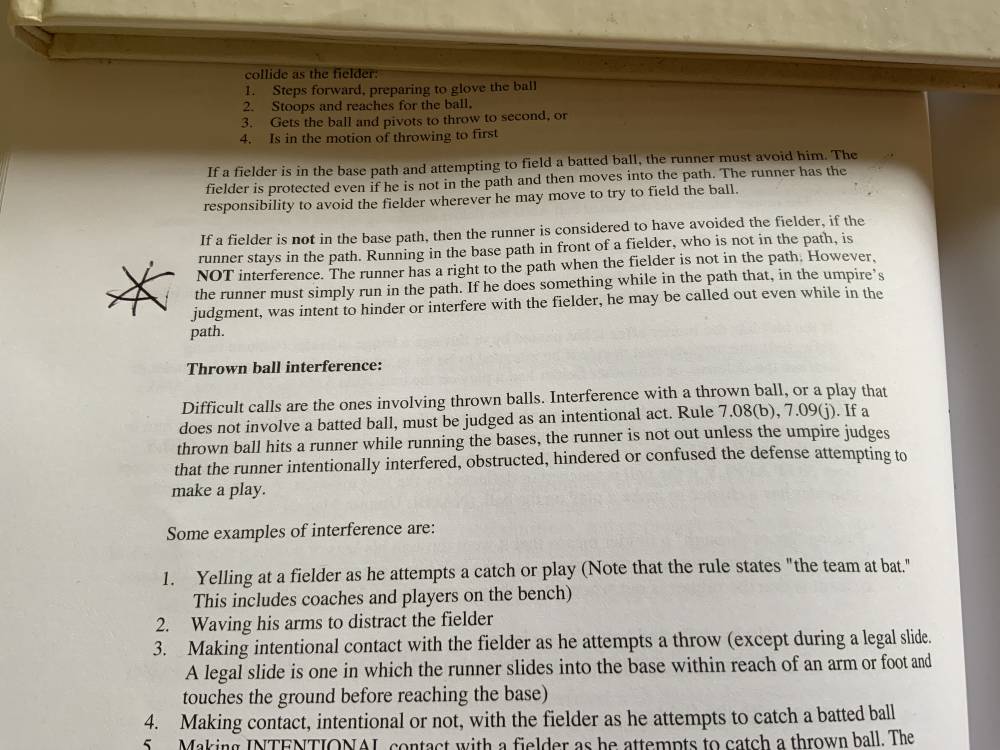
While not an official source I have found Jim Booth’s book, Baseball Rules In Plain English, to give an excellent interpretation of this play.
-
In the video I have interference. The fielder has the right to the ball even if he enters the runners base path. ‘However—if the fielder chose not to go after the ball and remained behind the runner I would not call interference.
-
I totally agree.
-
My issue was that this was the last out of the inning and the defense—to avoid an appeal—rushed off the field. ‘According to Mr. Childress you cannot change an out call to safe after 3 outs with runners on because you have no idea where to place the runners. I am asking in this situation should I have not gone for help once the defense was running off the field?
-
This happened a few years back and I just read in 151 ways to Ruin a Baseball Game that we were wrong—but am curious what you all think. 12U—OBR R1 &R2–2outs. I’m BU in the C Ground ball to F6–he throws to first. ‘Ball beats the runner but I think F3’s foot is off the base. ‘Before I make the call I ask PU—did he hold the bag? No response so I ask again—no response so I call B/R out. ‘Defense runs off the field ( their coach knew what happened and hustled them in) and then my partner says, “ Yes, he was off the bag” I cringe now thinking about it but I changed my call to safe, had the defense brought back and advanced the runners one base. How should something like this be handled?
-
Thank you sir, once again.
-
My daughter played Varsity softball for 4 years with an outstanding coach. Several times one of his infielders gave up on a batted ground ball to avoid, at least in their mind, getting trucked. ‘Not once did I see an umpire call interference The coach would , in frustration, yell at his fielder, “The ball belongs to you—go after it! BTW I really appreciate you referencing an actual MLB play on this—that is what I was looking for.
-
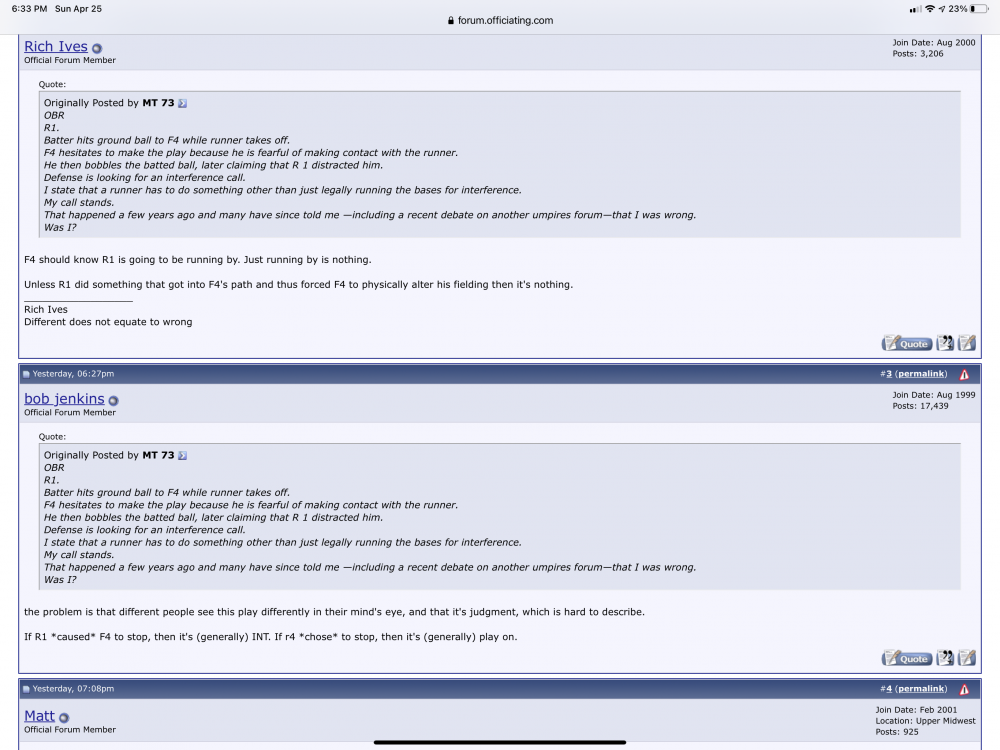
R1. Batter hits ground ball to F4 while runner takes off. F4 —who is playing about 8 feet behind the runner—hesitates to make the play because he is fearful of making contact with the runner. He then bobbles the batted ball, later claiming that R 1 distracted him. Defense is looking for an interference call. I state that a runner has to do something other than just legally running the bases for interference. ‘And that, in my judgement, the fielder chose not to make the play. My call stands. That happened a few years ago and many have since told me —including a recent debate on another umpires forum—that I was wrong. Was I?
-
OBR: Batter and runner are out if fair—even if uncaught Runner out for interference if foul. Even if the foul ball is caught batter is not out but resumes his count with the foul added as a strike.
-
Double play. ‘Had he touched the base first and then tagged the runner who is on the base then only the B/R is out.
-
I have seen players glove the ball and then immediately drop it on purpose to get a double play. ‘Though only in the glove for a second before being dropped I called the batter out for the intentional drop. ‘My question is this—-suppose the fielder allows the pop up to hit his chest and then pick it up from the ground. ‘Does this qualify as a touch?