Slippery Fish
-
Posts
42 -
Joined
-
Last visited
Everything posted by Slippery Fish
-
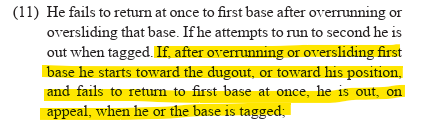
So if you have a standoff at home plate where neither F2 nor the runner are moving, that counts as an attempt to return and requires a tag? -- Also, should have done a bit more reading before I asked about 5.09(c)(3). I see in rule 5.09(b)(11) that you can appeal by touching the base if the runner is going back to the dugout or his position but hasn't yet committed abandonment. Never seen that, but I'm assuming that's there so you don't have to chase him down.
-
My coworker showed me a video the other day that made me realize I have some gaps in my knowledge. Couldn't find the original video but I found a similar play linked below. https://www.mlb.com/news/catcher-sits-cross-legged-to-block-home-plate Easy call in that video, runner gives himself up and gets tagged. Out. But let's say the runner didn't give himself. In the video I saw the catcher sitting on home plate and the runner stare each other down for several seconds before the runner made a diving attempt at home plate. Do we just allow this standoff to happen indefinitely? Or at some point can the catcher appeal the missed base by stepping on home plate? Also, is the standard different for plays at bases other than home? Finally, this is a side tangent, but when I was looking up this rule, I noticed rule 5.09(c)(3) right above it. Is that correct that the runner in this situation can be called out if the base is touched?! I'm thinking of a BR overrunning first base and the defense sails the throw to F3. BR takes a couple of steps towards second and then changes his mind and decides to return to first. Can he be called out if the defense touches the base, not just if he's tagged? Or am I missing something here? Any guidance is appreciated!

-
@Grayhawk, that explanation makes sense. I didn't catch the difference in batter/batter-runner verbiage. So by this interpretation, I kicked the OP because I should have been looking for "clear hinderance" rather than "inadvertent deflection". Correct? (TBH, I thought the standard was just contact with the ball 🤦♂️). My clarification question is, batter becomes batter runner on U3K, ball goes under the catcher and the umpire deflects it with his foot as he's trying to get out of the way. Play on? -- And just so I clarify the "inadvertent deflection" part of this rule. The way I'm understanding it is that if the umpire or batter hits the ball it meets the standard, but if the ball hits the batter or umpire it does not. By way of example, let's say we have R1 so batter does not become BR Play on, because the umpire was struck while in his stance (ball hits umpire). Dead ball if the ball falls to the ground and the umpire hits it with his foot as he's getting out of the way (umpire hits ball). Or for the batter, ball bounces off the catcher and hits the batter in the back of the leg. Play on. Ball bounces off the catcher and the batter kicks it backwards as he's backing out of the box. Dead ball. Am I thinking about all of that correctly?
-
I appreciate the context, @MadMax. Is this a rule that was changed sometime in the recent past? And I'll be honest, I'm still confused by this. Why do the rule and comment lay out very different standards for interference (i.e. the rule just requires "inadvertent deflection" (by the batter or the umpire), while the comment requires the batter-runner to "clearly hinder" the catcher)? I feel like they are trying to cover different situations, but I'm really struggling to see what they would be. How can a ball be inadvertently deflected by the batter without having first been deflected off of the catcher or umpire? Does the ball have to come to rest? And I'm going to respectfully disagree with Brother Dawg here. In OBR at least, I don't think either the standard in the rule (inadvertent deflection) or the comment (clear hindrance) require intent. I haven't looked this up in FED, but based upon this thread it appears there may be a difference.
-
Agreed...The question in OP is not whether this was a hit by pitch, but whether the batter is out because of the deflection.
-
Had an odd one in a game today. USSSA rules, so OBR. 11u if it matters. 1st batter of the inning. He swings at a pitch in the dirt that bounces off the catcher and then hits the batter in the leg. Catcher is momentarily confused where the ball is and the BR makes it safely to 1st. I am BU, and call time to confer with my PU. I tell him that I saw it hit the batter and want to double check the rule. We agree that the BR should be out and I call the BR out. For the moment I'll leave out the consternation that followed and just focus on the accuracy of the call. I looked up rule 6.01 after the game and now am about 50/50 on whether this was the right call. It's specifically the comment that is confusing me. In my play the ball deflected off the catcher first, but I'm having a tough time imagining any pitch deflecting off of the batter/batter runner that didn't deflect off the catcher or umpire first.
-
Thanks for the replies, this has made things more clear for me. For completeness sake, is engaging the rubber with hands together officiated/ruled differently in FED? I ask because there is a penalty listed for violations of the pitching position descriptions in FED rule 6.1.(1-3) that I don't see in the OBR rulebook. Also, I'm seeing in OBR that the requirement to come to a set position without interruption and in one continuous motion is in the pitching position rules (5.07), not the balk rules (6.02a). If a pitcher doesn't go from the stretch to the set in a continuous motion, is that just a "don't do that" and reset as well?
-
Had a situation this weekend that I'm not confident I ruled on correctly. USSSA Rules (i.e. OBR Balk Rules), 13U. R1, R2, pitcher in the set. I'm PU. Batter makes a base hit and all runners advance one base. I'm not sure how it even came up by my partner and the DHC get into a discussion about whether or not F1 balked. My partner said that the pitcher engaged the rubber with his hands together, and then "came set" with his hands still together before delivering the pitch. He didn't call a balk when it happened because he mistakenly thought that under OBR balk rules that he was supposed to wait until after the pitch was delivered. I somehow missed that this happened, which was a big error on my part. So, now there's a discussion about whether or not to let the play stand. I shared my opinion that the action wouldn't be a balk, but a "don't do that" where you tell the pitcher to step off. DHC disagrees and also insists that the ball should have been dead upon the violation. Ultimately my partner suggests that we acknowledge the balk, advance R1 and R2 and send the batter back to the plate. We are in earshot of both head coaches and it's agreeable to them, and unfortunately I wasn't confident in what the actual ruling was supposed to be so that is what we did. All that said: 1) Am I correct that this is not a balk? If so, I'm assuming the correct mechanic is to tell the pitcher to step off and start over. 2) If somehow a pitch is delivered after this violation, what, if anything, is the remedy? In this situation the offense came out fine, but I could easily envision a situation where the pitch is delivered or a pickoff is attempted that would disadvantage the offense.
-
Slide or avoid contact in lower-level baseball leagues
Slippery Fish replied to Central Cal Umpire's question in Ask the Umpire
I guess I just don't see the same slippery slope. I will grant, after re-reading the OP and Central Cal Ump's additional explanation, I was overzealous to suggest that R2 had likely violated a "must slide or avoid contact" rule (hereafter abbreviated as MSAC). A runner stopping at the base where the fielder is on top of the base with the ball, especially at the U10 level (I've fully bought into your admonitions to consider the context), doesn't sound like a violation. However, while different, I think all of the rules cited above are (appropriately) narrowly tailored to mitigate unintended consequences. I'm guessing the situation the rule writers had at the forefront of their minds is plays at the plate, which has received scrutiny at all levels. The specific rules in question don't ban contact wholesale, they penalize not sliding or attempting to avoid full on contact under very specific circumstances. LL says explicitly, and I would argue that USSSA says implicitly, that the fielder must be waiting with the ball, ready to make the tag. Cal Ripken requires you to be near a base too! This means that non-malicious contact occurring as a result of OBS, or the catcher standing on the plate without the ball, or the ball arriving shorty before the runner, or the fielder doing something out of the ordinary, isn't penalized under MSAC. Now, if I'm misunderstanding you and you're taking issue with haphazard attempts to regulate contact more generally, then I'm closer to seeing your point. -
Slide or avoid contact in lower-level baseball leagues
Slippery Fish replied to Central Cal Umpire's question in Ask the Umpire
I think we're conflating two different rules. (i.e. slide or avoid contact & retired runner interference) The exact rules will vary from league to league, so YMMV. To add to Velho's quote from LL, I've quoted the USSSA rulebook below. As much as I hate to disagree with Max, I think the thing to note is that both the LL and the USSSA "slide or avoid contact" rule applies exclusively to tag plays. In the OP, it sounds like there's a decent chance that R2 violated this rule. However, you'd have to judge how immanent the tag play was. That being said, even if you judge that he violated the rule, the penalty is simply that he is called out, which already happened with the valid tag. No, we wouldn't require him to slide (he probably doesn't have enough speed to slide), but we will require him to avoid immanent/evident contact (see LL's caveats above). Ironically enough, the only time I have ever called an out under this rule was in a rundown. Defense had R3 dead to rights in front of the plate, and R3 ran directly into the catcher causing him to drop the ball. I think "slide or avoid contact" is low and reasonable bar, and if R3 had done literally anything other than run right through the catcher's chest, he wouldn't have violated this rule. Regarding potential interference, I don't think that has anything to do with the "slide or avoid contact" rule, but is a question of general retired runner interference. Given the context, I don't think it's a necessary call in the OP, but I think it's a separate consideration from whether R2 successfully "slid or avoided contact".
-
Needing West Vest Shoulder Pads
Slippery Fish replied to Slippery Fish's topic in Buy, Sell or Trade
Back with my post-game review! First, I want to thank Max for all the time he put into working with myself and Michael on designing this project. Second, I want to thank Michael working with me through this process. I asked for a lot of novel things and extra customization, and he delivered! I’ll start with the things I liked. I love the new bicep pads, they fit wonderfully under my shirt without looking too bulky but still providing that extra protection. I also like the slenderness of the pad itsself. It was 60 degrees last Saturday so I didn’t have a good test in the heat, but I anticipate that it will be much cooler than the old foam. I also had Michael make the pad narrower than it was before, and the arm mobility I have vs before the refurbish has improved quite a bit. All that being said, I am unfortunately struggling to get it to fit me well. Specifically, I can’t seem to get it to stay snug against my body, particularly up at the collar bones and neck IMG_2292.mov when I get down into my stance. I took a video to hopefully show what I mean, I don’t know if the issue is visible from that angle or not. I did a couple of games in a row and it became more pronounced the longer I wore it. I’ve tried pulling the harness straps as tight as they would go, and that helped some, but then I couldn’t get it back off without flipping it around and loosening the straps. I’m open to any ideas to try! I suppose it’s possible that a Platinum CP is just too big for me, but I’d like to exhaust my other options before moving on to a different piece of equipment. -
Needing West Vest Shoulder Pads
Slippery Fish replied to Slippery Fish's topic in Buy, Sell or Trade
Hello All! After several months of scheming, crafting, and a literal hurricane, the time has come! I’ve gotten everything sized right, fitted it with a brand new Ump Life harness, and tomorrow, I will be taking this CP on it’s maiden voyage!
-
Two very poorly thought out local league rules
Slippery Fish replied to FourthOut's topic in Youth Recreation Ball
Can BU call an out for hitting with the foot outside of the batter’s box, or is that soley a PU responsibility? It seems like the BU, especially in B or C, would have a better chance of actually seeing if it happened. -
I apologize for re-opening this thread after it feels like a consensus was reached, but this is my first year doing a substantive amount of FED games, and I'm trying to make sure I'm crystal clear about the nuances of the slide rules. Specifically, my reading of the rules tells me that a runner can (with many exceptions) slide at a fielder on a tag play, and I want to make sure I'm correct about that. The situation that comes to my mind is R1, less than 2 outs, and a base hit to right field. R1 gets aggressive and tries to reach 3B. The throw from F9 beats him by a couple of steps, but pulls F5 to his right (i.e. between 3B and home). R1 elects to slide to the side of the bag where F5 is standing, possibly to break up any play on the BR, and completes an otherwise legal slide (i.e. one leg and buttock on the ground, close enough to reach the bag with his hand, no cross body, no cleats up etc). He comes into contact with F5 who either cannot complete the tag or is hindered from making a play on the BR. Am I correct to say that, by rule, this is a legal slide? My gut tells my that I'm wrong about this conclusion, but unless you judge MC or that the runner was trying to injure the fielder rather than just make his life difficult, I'm struggling to build a case that it's illegal. Is there just an assumption that in most cases the runner will slide to the other side of the bag like @noumpere mentioned? Or that tag plays are too unpredictable to force the runner to slide directly at the bag as @Velho speculated?
-
Does the advice to change your mask pads every 1-2 years not apply to Team Wendy’s?
-
Looks like I need to start a return on my last Ump Attire Order...
-
Appreciate the discussion! I think one of the tough things about this for me is that there's really no way to practice this. If someone's holding back a drill to practice making yourself more assertive or practice changing a call now would be a good time to share After reading though this discussion and reflecting on the situation some, I think what I need to do to grow is force myself to make what I think is the correct call, even if I feel like it's very late. I wouldn't do this in situations where I've already made a call (e.g. safe/out, at least without new information) but I could see it working in others where you "play on" unless a call is made (e.g. BI, CI, balks). The downside would be catching flak for making a call late (or at least feels that way), but hopefully it could make me more assertive over time? Thoughts?
-
Thanks for the help! Fully agree now that the pitchers were in the set because of their foot position. That seems pretty cut and dry. I want to make sure I fully understand why the rocker step itsself is disallowed. Is it because, as Tog Gee referenced, a step forward, sideways, or backward and forward are explicitly allowed in the windup that they are implicitly disallowed (and therefore a violation of 6-1-3) in the set? And one follow up on enforcement. I like the idea of catching this during the warmups if you can. But say you didn't, or the pitcher just didn't use his windup in warmups. Are you allowing the pitcher to complete a pitch and then calling an illegal pitch (or balk), or are you trying to stop him once he does it but before he delivers?
-
I only can ask this question by way of example. Yesterday I had a situation with R1 and R2. The pitch is delivered and the batter checks his swing while R1 and R2 take off. B1 then takes a step back in the box, and the catcher cocks his arm to throw but holds up because the batter is in front of him. R1 and R2 complete their steals safely. I watch all this, and for some reason don't call interference.* It takes me a second to process what all just happened (check swing and potential interference), but I don't call anything and start to move on. The catcher then turns around and asks me, "Is that interference?." Shoot. "Uh, no." "Well he can't take a step back right, did he take a step back?" I respond with something like, he did, yeah, but it was after you made your attempt, yada yada. I don't really remember, it was complete B.S. I think I was really nervous to make it look like I was changing a call after he asked me something. Between innings, the coach comes out and very respectfully says that his catcher wants to know what he is supposed to do when the batter takes a step back so he can know for next time. At this point, I have no other answer than, "Coach, I messed that call up. That was interference and your catcher didn't do anything wrong, I just missed that call." Fortunately for me, he's perfectly happy with that answer, and we move on. I let the catcher know the same thing when he comes out the next inning, and we play on. My underlying question is this. If a coach or player asks you something after a play and you realize that you made an incorrect call (or no call), do you just go ahead and change it? What if no one asks you, but you realize that you missed something? I've tried a few different approaches. On straight judgement calls, I try to just own my original call. "Coach, I had him making the tag before the runner got his arm there" even if I think I may have been wrong. One more complex rulings, I've occasionally met with my partner to give myself cover for changing a call, but given that the infraction in question was BI, I didn't feel like would make much sense. I was very fortunate that this scenario did not become an issue, but this easily could have become a $#!* show. If you do change a call, how do you go about explaining it to the opposing coach? I realize the best outcome is to be extra familiar with the rules and call infractions when they happen. But it still happens to me every once in a while that several seconds after the dust settles, I realize there was a call to be made, and I want to be better prepared to handle that again. *As an aside, this is interference, correct? I've always worked under the assumption that a right-handed batter taking a step backwards after his swing, even if he remains in the box, is likely interference if there is an attempt to put out a runner on a steal of 3rd. I just never see it called (albeit I typically work 14u or lower), so it makes me hesitant.
-
I saw two acts by pitchers yesterday that I was unsure how to officiate. I believe both of these are violations of the pitching rules, but I wasn't sure how to administer them. Situation A: Pitcher delivers his windup from what I would call a "hybrid" position (I know there is no hybrid in NFHS). I say hybrid because his pivot foot was parallel to the rubber, which would put him in the set position, but he began his delivery by taking a step backwards with his non-pivot foot. He did not typically do this with runner on base, but did when there was R3 only (i.e. a time where it is typical for pitchers to be in the windup). Situation B: Even stranger. The pitcher's foot is parallel to the rubber and he engages the rubber with the ball in his hand and "stretched out" to take the signs. He then "comes set" and brings his hands together and pauses. Then, he does as the pitcher above and takes a small step backwards with his non-pivot foot before making his delivery (hybrid?!). He does not take the extra step with his non-pivot foot with runners on base. I guess my underlying question is twofold. 1) is it illegal for a pitcher in the set to take an extra step with his non-pivot foot before making his delivery? Allowing this feels counter-productive to the delineation between set and windup, but I'm struggling to find wording in the rules governing the set position that would prevent this. Maybe the balk rule 6-4-d for failing to complete the pitch in a continuous motion? But then that'd only be an infraction with runners on base? Any advice is appreciated.
-
Gotcha, @MAUmpire, I misunderstood what you were getting at with your question. Short answer: because the rules say so 😁 Longer answer: Philosophically, I’m not sure why this situation is different than a ball bouncing of 2nd base and hitting R2, for example. My speculation is that the “in fair territory” provision is there to protect runners on 3rd from being called out on an otherwise foul ball. I honestly think this is just an edge case that whoever wrote the rules didn’t think to flesh out. Other than deflecting off a fielder, I can’t think of a single other situation where a runner would be hit by a fair ball in foul territory, and I think it’s highly unlikely that any of us ever see the situation in the OP actually occur.
-
Thanks for the find, @jimurrayalterego. I missed 5.1.1.N when I was studying the questions. I looked in the rule 8 case plays, but didn't think to look in rule 5. I agree that the wording of the rules contradicts the case plays is "confusing", but now I at least have confirmation of how FED wants this play officiated. The reason the runner isn't out is because he's in foul territory, not because the ball hit the base. The ball bouncing off the base is just one of the few ways a runner in foul territory could conceivably be hit by a fair ball.
-
I missed the following question on my NFHS rules exam: Q: R3 takes his lead off third base in foul territory. B2 hits the ball, and it caroms off third base and touches R3 who is still in foul territory. What is the correct ruling? A. R3 is out. B. The ball remains live. C. The ball is dead. D. R3 must return to third. I answered A, and it was marked incorrect. I was not given the correct answer. 8-2-k says that any runner is out when the runner "is contacted by a fair batted ball ." Rule 2-5-1-e says that a fair ball is a batted ball that "touches first, second, or third base". So, the status of the ball in the question is a fair ball because it touched third. Then it touched the runner (w/o passing through or by an infielder), so the runner should be out. Right? Apparently not FWIW, my gut feeling was that the runner was not out, but I couldn't justify that with my reading of the rules. Looking back, I believe I felt this way because OBR 6.01(a)(11) says that a runner is out if "a fair ball touches him on fair territory," which is an extra requirement that I don't see in FED. I'm assuming the correct answer is B, but I'm not for certain. Any help understanding this would be much appreciated!
-
Thanks again for the help. Properly addressing coaches has been one aspect of my game that I know is lacking, and this gives me a good starting place to start working on that on the field. No offense taken at all, it's a perfectly valid point to consider. I get a lot more crap with the youngest age divisions, and I know I'm not as good in those games as I'd like to be. It's that umpiring paradox that better, more serious baseball is easier to officiate, so I try to work the best baseball my work schedule and skills will allow. That being said, I know I'm a lot better than I was last season. I went to the Mid-America clinic last fall and they made a lot of adjustments to my plate mechanics. I'm actually confident that I know where the pitch was now. I'm a big fan of clinic environments, but I still come on here for in-season education Thanks for the tip! For all the times that I've seen this referenced on U-E, I'm just now realizing that this is an actual book and not just a slang term.
-
Thank you all for your feedback, this has given me lots of good things to think about this week! I can't tell you how greatful I am for your responses. Certainly trying to become a better umpire little by little. I definitely need to get better about owning calls that are mine, and taking on less games in a weekend is something I'm strongly considering. This is something I see people say all the time, but to be honest during the moment it often feels like the opposite is true. It seems like in the situations where the coaches are the most fired up, all of the coaches and all of the parents are bearing down on you, and it feels like ejecting somebody in the heat of that moment would be like throwing a firecracker into a fire. Is there any validity to that, or am I just paranoid? I don't know this for sure, but just from reading this site it seems like the short leash on ACs is much more ingrained into the culture of HS ball and higher than youth ball. In a situation like this, would you call time and walk over to the HC to address something like this? I try not to stop the game or yell across the field if I don't have to, but if it would improve my game management I am willing to adapt. After reading the responses to this question, I think I may be letting coaches have too much leash when it comes to comments about my strike zone. One big challenge for me is that the complaints usually aren't directly at me ("that's a terrible call, blue"), but more subtle. One thing I get a lot is coaches asking "where was that?" about a pitch that they didn't like. I usually answer them, but there are definitely times where it feels like this gets out of hand. Do you guys usually answer coaches when they ask that? Or do you ignore it or give another response? The other challenging thing for me is that often it seems like coaches will usually make their displeasure known by talking to their players and saying things like "that's a good pitch little Jimmy," or "Hey, that's not you batter." Obviously sometimes they're encouraging their pitcher or batter, but you can tell by a coaches tone when he's just complaining about the strike zone while trying to keep plausible deniability and putting the umpire in the position of looking like the aggressor if he addresses it. Any advice on that?