RBIbaseball
-
Posts
297 -
Joined
-
Last visited
Everything posted by RBIbaseball
-
Forgive my ignorance, but what are you talking about? I mean I read the link, but not sure what their impact is or what you're saying it should have been.
-
Oh okay, yep. I get that.
-
So anything B -> C and beyond balk all day. I can get on that train. Thanks
-
Not sire what You mean. A RHP has the right side of their pivot foot off the rubber toward 2B to start? Meaning they don't have to move very much to disengage?
-
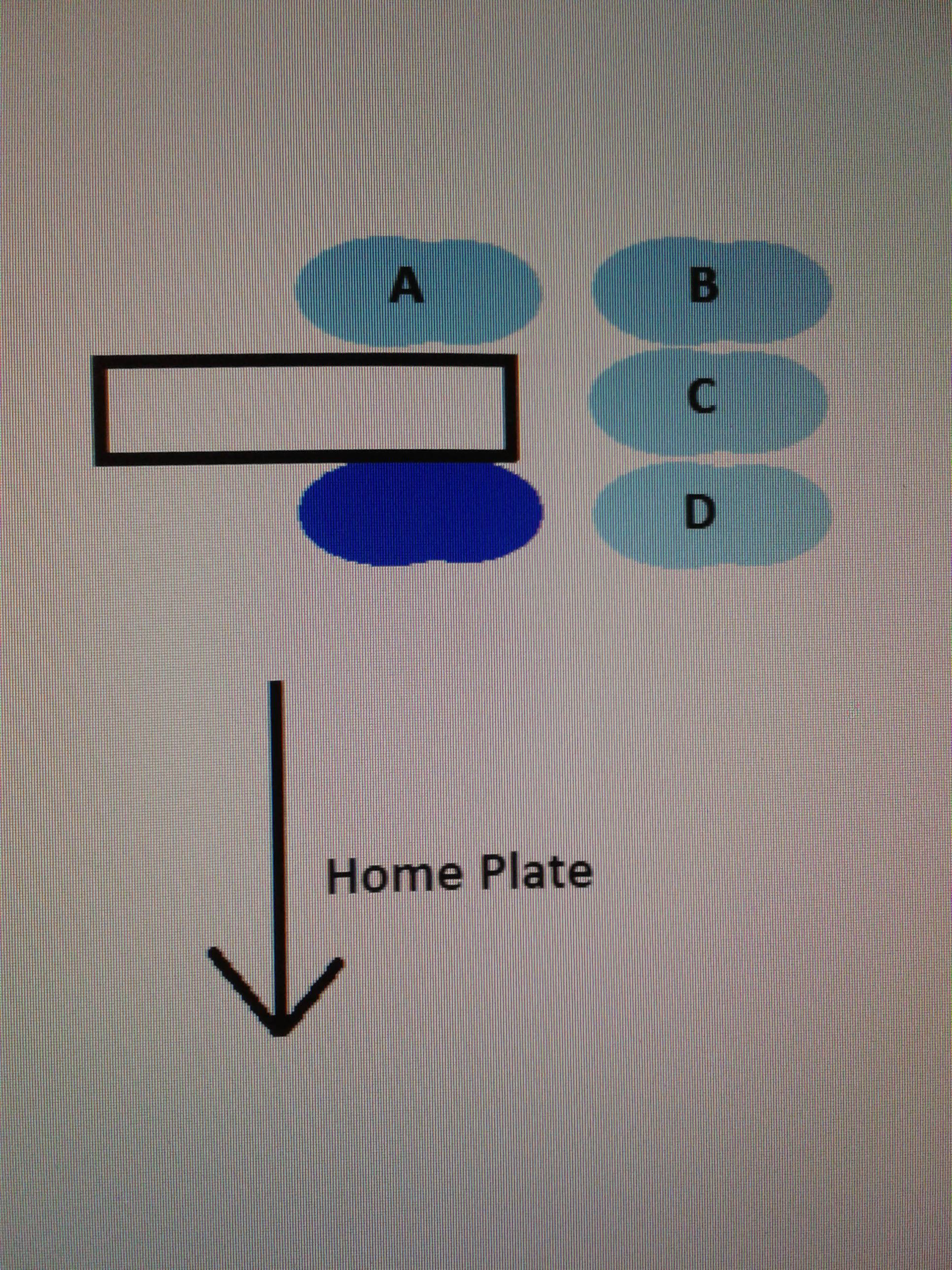
The only verbage I see defining how to properly disengage the pitchers plate is "backward". What qualifies as backwards... only directly back? As in directly toward 2B, or is there a little room to play? See my image below. A is obviously good, but what about the rest? I had a 13yr old kid stepping off more like C and was letting it go. At what letter should I draw the line, or is it somewhere inbetween?

-

Intermediate LL Baseball - feint to 3B
RBIbaseball replied to RBIbaseball's question in Ask the Umpire
Thanks Grayhawk. Appreciate you guys not giving me too hard a time for these noob questions, lol. -
Intermediate LL Baseball - feint to 3B
RBIbaseball replied to RBIbaseball's question in Ask the Umpire
Just to clarify, correct on the pause and the forward? Another question regarding pickoffs... Can a pitcher perform a pickoff move or disengage the rubber in the middle of moving from the stretch to the set position? Or once he starts his natural movement from going from the stretch to set, does he have to come set before making any other movements? Last question. Someone asked me this and I didnt have a great answer. Why does a pitcher have to come set? What I mean is, why does the rule exist? What advantage is it taking away from the pitcher? -
Intermediate LL Baseball - feint to 3B
RBIbaseball replied to RBIbaseball's question in Ask the Umpire
Poorly worded perhaps. I understand it's not a balk when executed properly. My question is, is there anything to look for when the pitcher executes it to call a balk? I had a pitcher raise his knee up, start the spin (leg moved a few inches), pause for about a half a second, then finish the spin and he choose not to throw ... Did the pause make it a balk because he didn't step directly to second? Also, if the pitchers free leg moves forward toward the plate at all, he can no longer make the move correct? -
I have been asked to be on the bases for the state championship tonight (2 man crew) and according to coaches/UIC, I have pretty much been the only one calling proper balks the entire tournament (thanks to you guys). But... The local UIC tried to convince me of a few intricacies with pickoff moves. Please clear the air for me, as I am unsure. Please correct me if I'm wrong on any of this... Unlike MLB, According to LL rules, a feint to 3B is still legal. 8.05(b) The above being true, the UIC told me a LHP can't feint to 3B on a pickoff move where he doesn't first disengage. But by my understanding that is irrelevant. He said only a RHP can feint on a direct step with his free foot. ?? He also said that in LL the feint to 3B, throw back to 1B "trick" play is not legal, but I see nothing in the rulebook that precludes that. A RHP can step with free foot, feint a throw, and then step and plant pivot foot for a throw back to 1B correct? Can someone please explain when the traditional 2B spin move pickoff is a balk? My not so common sense tells me it is not a direct step, although I understand it's legal. Point being, as long as it's a continuous motion toward 2B it's good? (Ie No pauses, no free leg moving toward the plate) Thank you guys.
-
I believe what was discussed above is OBR, so Im guessing Fed is immediate? Meaning every balk kills the play immediately and everything is a no pitch, batted or not? If not please explain.
-
There is a lot of great discussion back and forth here. But I just have to jump back in one last time, even though I said I wouldn't.... When you say "he did", that is a judgement call. Both myself and the other BU, (who were there in real life), were not convinced the player was actually appealing or that he even heard his coach through the 40+ fans and entire dugout yelling. Example of all the things that were being yelled at the same time by 40+ people: "Tag the runner, tag the runner!" "Touch the base, he didn't tag" "Throw it to second!" "2, 2, 2, 2!" "Tag him Johnny" "He left early!" "He didn't tag!" "Go back to second" (offense side)" "Stop, stop, stop! (offense side)" "Nooooo!" "Goooooo!" "There's two outs already!" "Only 1 out, get em!" Obviously, I did my best guess on the myriad of things being yelled, but the point being, it was chaos for that kid. I'm not sure if he made out a single command independently from the combined yelling. The kid caught the ball as the runner (who was about two arms length away and most likely could see him in his peripheral) ran right in front of him. The kid then applied the tag as quickly as he could after catching the ball (less than 2 seconds after touching the base in my estimation). Simply comparing it to a throw back to 2nd where there is no other possible reason anyone would ever make the play is unfair in my opinion. As I have stated in many previous posts in the thread, many of these kids would routinely apply tags to runners after they reached base safely (sometimes 4 or 5 seconds after) and look at me for a call (which I would just look at them back, until they threw it back to the pitcher). Take it with a grain of salt, as I have less than 15 games under my belt. One thing is that I am convinced is - that during that play - I was not convinced the player was appealing the play vs tagging the runner cause that's what he knows how to do. I was unsure to say the least and felt strongly that it was the latter. If you still feel that you would grant an appeal on the play, I will not argue that you are wrong, but I definitely don't think its a clear and shut case like you make it out to be. My take away is that it's a judgement call on intent to appeal.
-
I know there was some sarcasm there, but I wish I did have someone to demonstrate mechanics to me, but anyone I start asking questions to I realize knows less than I do (either rules or mechanics), and once they try to convince me something I know that is right, is wrong, then I stop asking them questions. But anyways, yes, I was implying that it was 3rd strike (dropped 3rd strike) on my last note. When you said the out stands, are you talking about R1 advancing to 3B on a past ball and getting thrown out at 3B? If so, ya I understood that. He is only protected to 2B and anything beyond that is at his own risk. So since I passed the test (thanks for the link and the explanations @noumpere < thanks), just curious what side of the debate you were on? lol p.s. just got back from my 13-14 yr old game and felt like a boss out there with my balk knowledge. My PU was just like (I'm gonna let you call all the balks after I gave him a brief explanation of what I found out here). Confidence boost 1000. Thanks again.
-
@Jimurray Hopefully this isn't over simplified, but this is what I took away. If I'm wrong please correct me. Whenever there is a balk, always point and verbalize "Balk!" or something along the lines of "That's a Balk!", then assess the situation... Did a throw (pick off throw or pitch) happen or is a throw imminent - if NO - Immediately call "Time" and enforce the balk Did a throw (pick off throw or pitch) happen or is a throw imminent - if YES - let the play unfold was the pitch or pickoff attempt caught by the defense - if YES - Call "Time" and enforce the balk was the pitch batted into play OR was the pitch or pickoff attempt wild (past the defender) - if YES - let the play unfold Once it's clear that the batter and all runners (just runners on pickoff) cannot or won't advance at least one base safely then call "Time" and enforce the balk from where everyone started (examples: Caught fly ball, ground ball stopped by the infield where runners don't all advance, caught pickoff throw) If the BR and all runners (just runners on pickoff) advance at least one base, then let the play stand Notes: If the pitch happens and it is judged ball 4, and the BB would force all runners to advance, then allow the play to happen. Otherwise call "Time" (no pitch) and enforce the balk. If the pitch happens and it is swung on while also a wild pitch and the BR and all runners advance one base, then let the play stand. Otherwise call "Time" (no pitch) and enforce the balk I wrote this up real fast cause I got to go, so I might have missed something important.
-
Thanks for the homework @Jimurray . Did you mean to provide a link to the thread? Or is that part of the fun?
-
I have my first games tonight with "balk age" kids. I have a good idea and am confident in what a balk is and isn't, but I can't find any information on how to properly call it. Is it always a delayed dead ball? Or is that only when the pitcher is in motion to throw? Do you say "Time" first? How does the PU move as he calls it? When do you just kill it vs allow time for a pitch/ overthrow to happen? A few common scenarios of how to signal a balk properly would be extremely helpful. Also, as an aside to the mechanics... Does a batter receive a base on balls if the pitcher throws a ball on a balk?
-
Good catch lol. Correct. And to be clear, once the runner started to loop around, the fielder never took a step with his plant foot but only stepped 180 with his lead foot toward 2nd base.
-
Although there is a bit on disagreement on my scenario, I have learned a lot about what an appeal is and isnt, so overall net positive, lol. THANK you to everyone. I'll let you guys keep going it at.
-
Good question. No idea. I get your point.
-
@maven Thanks. I appreciate the feedback. Seems like I had a real good idea what I was doing this time. Wish that was always the case lol.
-
But I am judging the intent of the kid tagging. What if the runner was one step slower and the kid went to tag him while he was off the base but was a little slow and didn't reach him until he touched. (Coaches / crowd would have still been yelling to tag him) ... would that tag be an appeal or a regular attempt at an out? And to me that's relevant in this case because several times in the game a kid would catch the ball and run over to tag a player who was safe on the base for 3sec or more... we're those appeals or kids just tagging people cause that's what they know. I think the players intent is in play. That all being said, I think next time I would be inclined to call him out based on the age level and all your guys input. I totally understand what you're saying.
-
My initial post was unclear, but he was tagged out a couple steps before reaching 2B.
-
Did you consider my point about the initial tag that missed and does that baseline cease to exist? That part seemed unclear to me.
-
That's why I question it and am a little unsure. He was definitely avoiding a potential tag, but a tag attempt never happened. A tag attempt did happen about 4-5 steps prior but clearly separate from his decision to loop around.
-
Here was another one that happened for me yesterday. Hopefully I can accurately describe what I saw. Bases clear, no outs. BR hits a ball to the outfield and gets caught in a rundown between 1st and 2nd. I was positioned on the infield grass about 6-8 feet away following the rundown. Initially F6 caught the ball on 2B base with the BR about two or three steps away. Both turned back for 1B. At about the half way point, F6 had gained enough ground that he went for the tag (first with the glove, then pulled the ball out and swiped again with the hand). The BR was looking back as he attempted and was able to arch his back and clearly avoid the tags by a few inches. A few steps later as they both caught their balance (at this point about 10-12 feet from 1B) F6 stopped to throw to 1B, but as the BR saw him set to throw, he turned and looped around back toward 2B. When this happened, he clearly ran more than 3 feet outside the previous established base line (probably 5-6 feet), but I let the play go. Everyone (crowd and dugout) yelling for him being outside the baseline as you could imagine. As he started to turn and loop around F6 made no attempt to tag. F6 moved from his stance (ball in air behind his ear) where he was aimed at 1B for the throw and did a 360° [edit: meant 180]pivot bringing his front foot around toward 2B for the throw (ball remained behind his ear cocked to throw the whole way). The throw into 2B was dropped and the BR was now safely on 2B. Coach came out to discuss the call. I said something along these lines, "Coach, this is what I saw. I did not see a tag attempt on the runner as he changed directions. To be considered outside the baseline, the runner has to be avoiding a tag. Because your fielder was trying to throw to first, then changed his throw to second, without ever attempting to tag the runner, I cannot call him out for running outside the baseline. If he would have attempted to tag him it might be a different story." He seemed quite satisfied with my reasoning and told me thanks for the explanation and went back to the dugout. Was my call correct? Does the baseline "reset" after a clear separation in a tag attempt vs another play? Running 5+ feet around a fielder that does not make any attempt to tag is legal for the runner? Right or wrong, I got to say I was happy with how I articulated it. It at least avoided further heartache.
-
I think this is the point of contention. Would it be fair to say the players (defense) have to show intent/understanding on what they are doing (or at least reciprocate verbally what the coaches are telling them to say/do), or do the coaches yelling (among crowd/bench noise) from the dugout while a kid applies a tag suffice? Differing opinions on this one, but in the end seems like judgement depending on how the play went down.