spark2212
-
Posts
131 -
Joined
-
Last visited
Everything posted by spark2212
-
Situation: bases loaded in a tie game in the bottom of the ninth. The batter produces a base hit that then bounces out of play for what would normally be a ground-rule double. However, since the winning run started at third only a single is needed to end the game. Is this still a ground-rule double and how many runs score on the play?
-
MLB
-
Let’s say someone hits a home run but gets hurt and can’t finish running the bases. Can someone run for him? Does his run automatically score? Is he out? What happens?
-
It’s under options (next to edit).
-
Aww, I have too much fun watching the games from home. But thank you.
-
I like to point out to the side on swinging strikes, and more out in front on called strikes. (Again, I don’t umpire, but I like to call games from home.) 5B36E286-4BF4-4253-B9CF-4C49E6504CEB.MOV
-
I guess I’m wondering is there any reason NOT to signal swinging strike and THEN out on a caught swinging third strike? 8E41B211-4BF9-4C4B-9545-F53E6E2800F5.MOV
-
Is that Mr. Hornsby?
-
From what I’ve noticed, even umpires who normally use the point signal will give a hammer strike for strike 3 swinging.
-
Also, while I find “pulling the chain” to be quite fun just as a stand-alone action, I’m curious why it entered the umpiring repertoire, and how it became so ubiquitous.
-
Because I meant something more like this: (and yes, those are both me.) 9EA79B7A-B8CD-4721-8F18-C7A22439E1DF.MOV
-
You mean this? 5C028F66-D1E7-4564-9D98-DD7D6615C2FB.MOV
-
I watch a lot of baseball games, and I’ve noticed that typically HP umpires don’t signal strike (they just clench their fist like an out call) on swinging third strikes caught cleanly. Is there a reason for that or could you also signal strike 3 swinging, and then out if it’s caught cleanly?
-
Yes. While runners are required to tag up on fly outs, since the batter is already out, there can be no force play. Therefore, this is a timing play.
-
Runner obstructed at 3B, is awarded Home, but never touches plate
spark2212 replied to a question in Ask the Umpire
I’m pretty sure his shoe clipped the edge of the plate. -
No. No run can score on a play where the third out is made by the batter before safely reaching first. In fact, the runner reaching the plate first is irrelevant.
-
I’m just curious, can an umpire change his mind once he’s ejected someone (i.e. uneject them)?
-
Batting from outside the batter’s box—procedure
spark2212 replied to spark2212's question in Ask the Umpire
So what happened? Was he safe or out? -
It strikes me as rather unlikely that the obstruction would go unnoticed by the umpires (especially in upper levels of play where there are multiple base umps). Also, you run the risk that a runner who wasn’t actually planning to advance (and was instead simply trying to force a throw) gets a free base.
-
Catcher kicks ball into fair ball causing it to go foul
spark2212 replied to a question in Ask the Umpire
Again, the defense first interacted with the ball in fair territory. Whether the ball was moving or not, it’s a fair ball. -
Catcher kicks ball into fair ball causing it to go foul
spark2212 replied to a question in Ask the Umpire
Fair ball. The defense interacted with the ball in fair territory. -
There is a big difference between letting the ball drop (batter is not out except from IFR) and starting to catch the ball, then changing your mind and letting go of the ball (batter is out but runner do not have to tag up).
-
By rule, no runner can advance beyond the base to which they are entitled on a dead ball. You cannot steal a base on a hit batsman, whether that results in a HBP, strike or ball.
-
No. R1 is out if the defense appeals at second; either way, the batter did not pass him. If he was out at second, he is removed from the play and cannot be passed, and if he wasn’t, then—I assume the batter didn’t physically run in front of R1?
-
Balk rule w/runners on second & third, first base open
spark2212 replied to a question in Ask the Umpire
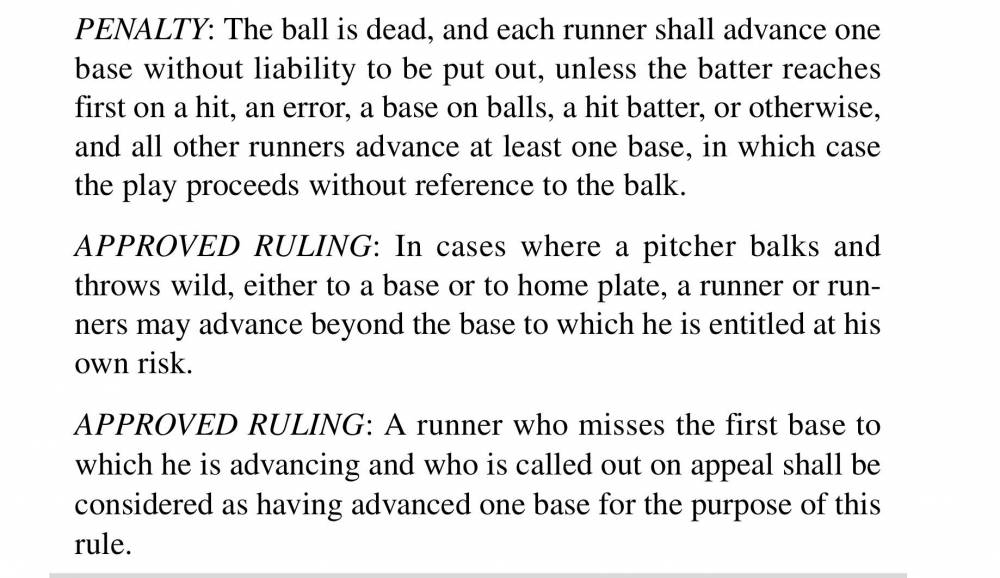
On a balk, all runners (except the batter-runner) are entitled to advance one base. If the ball is delivered home, it is not normally a pitch; however it is a delayed dead ball, so if a play ensues in which all runners (including the batter-runner) advance safely one base (via base hit, walk, error, or anything else), play continues without reference to the balk. (At least in the MLB) See OBR 6.02